

What Is NPSH in a Centrifugal Pump?
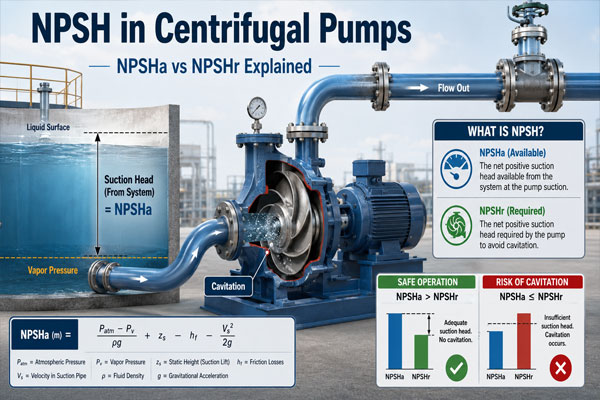
If you work with centrifugal pumps, you have heard the word NPSH. It stands for Net Positive Suction Head. In simple words, NPSH is the amount of pressure you have at the pump suction, measured in meters of liquid, above the vapor pressure of the liquid being pumped.
Why does this matter? Because if the pressure at the pump suction drops below the vapor pressure of the liquid, the liquid turns into vapor bubbles. These bubbles collapse inside the pump and cause centrifugal pump cavitation. Cavitation damages the impeller, causes vibration, and shortens pump life. The whole problem starts with NPSH.
This guide will explain what is NPSH in centrifugal pumps, the difference between NPSHa and NPSHr, how to calculate them, and how to use this knowledge to keep your pump safe. We will keep it simple — no heavy engineering jargon.
Two Types of NPSH: NPSHa and NPSHr
Engineers always talk about two types of NPSH. They are not the same.
NPSHa — NPSH Available (From Your System)
NPSHa is the pressure your system actually gives to the pump suction. It depends on:
- The pressure in the suction tank (atmospheric, pressurized, or vacuum)
- The static height between the liquid level and the pump centerline
- The friction losses in the suction pipe, fittings, and strainer
- The vapor pressure of the liquid at its current temperature
NPSHr — NPSH Required (By the Pump)
NPSHr is the minimum pressure the pump needs at its suction to work without cavitation. The pump manufacturer tests this in the lab and publishes it in the pump curve. NPSHr changes with flow — it rises as flow goes up.
How to Calculate NPSHa
Here is the basic NPSHa formula. It is measured in meters of liquid.
NPSHa = (P_atm / ρg) ± H_static – (P_vapor / ρg) – H_friction
Where:
- P_atm / ρg = Atmospheric pressure head (about 10.3 m of water at sea level)
- H_static = Static head from liquid surface to pump centerline (+ if below, – if above)
- P_vapor / ρg = Vapor pressure head of the liquid at its temperature
- H_friction = Total friction loss in suction pipe, valves, and fittings
Simple Example: Water Pump at 30°C
- Atmospheric pressure = 10.3 m
- Static suction head (tank above pump) = +2 m
- Vapor pressure of water at 30°C = 0.43 m
- Friction loss in suction line = 1.0 m
NPSHa = 10.3 + 2 – 0.43 – 1.0 = 10.87 m
If the pump NPSHr at the duty point is 6.0 m, then NPSHa (10.87 m) is well above NPSHr. The pump is safe from cavitation.
The Golden Rule: NPSHa Must Be Greater Than NPSHr
For a centrifugal pump to work without cavitation, the rule is simple:
Most engineers add a small safety margin on top, often 1 to 2 meters of head for cold water, and more for hot or volatile liquids. This safety margin protects the pump during small changes in flow, temperature, or system pressure.
Key Takeaway: NPSHa is what your system gives. NPSHr is what your pump needs. Always make sure NPSHa is at least 1–2 meters above NPSHr.
How to Find NPSHr
You do not calculate NPSHr. You read it from the pump performance curve that the manufacturer gives you. Every pump curve shows NPSHr on the y-axis and flow on the x-axis. As the flow rises, NPSHr rises too.
If the pump is older or the curve is lost, your pump supplier can run a test or give you an estimate based on the model. Rinku Engineers can also help you read the curve and match it to your system.
NPSHa vs NPSHr: Side-by-Side Comparison
To accurately determine these values for your system, it is highly recommended to first understand your overall pump head and flow rate.
| Feature | NPSHa (Available) | NPSHr (Required) |
|---|---|---|
| What is it? | Pressure your system provides | Pressure the pump needs |
| Where does it come from? | Your piping, tank and liquid | Pump manufacturer test data |
| How is it found? | Calculated from system data | Read from the pump curve |
| Changes with flow? | Yes, with a small change | Yes, it generally rises with flow |
| Changes with temperature? | Yes, because vapor pressure rises | Only a small change |
| Who controls it? | Plant design and operation | Pump design |
| Goal | Keep it as high as practical | Select a pump with a low requirement |
What Happens If NPSHa Is Less Than NPSHr
If NPSHa falls below NPSHr, the liquid cannot stay in liquid form at the pump suction. It flashes into vapor, and the result is cavitation. Here is what happens step by step.
- Liquid pressure drops below vapor pressure at the impeller eye.
- Vapor bubbles form and travel with the liquid.
- As the liquid moves into higher pressure zones, the bubbles collapse.
- Each collapse sends a tiny shock wave into the metal.
- The impeller surface gets pitted, vibration rises, and performance drops, often leading to low discharge pressure.
How to Increase NPSHa
If your NPSHa is too low, here are simple ways to raise it. In some difficult applications, complex NPSH problems can also be solved by upgrading to a self priming pump design.
- Raise the liquid level in the suction tank so the static head helps more.
- Use a larger suction pipe to lower friction losses.
- Reduce the number of fittings on the suction side (elbows, valves, tees).
- Clean the strainer and foot valve to remove blockages.
- Cool the liquid before it enters the pump. Lower temperature means lower vapor pressure.
- Lower the pump speed if possible. Lower speed usually lowers NPSHr.
- Pressurize the suction tank with a small pressure pad or nitrogen blanket.
How to Lower NPSHr
You can also pick a pump with a lower NPSHr. Some pump designs are better for low-NPSH applications.
- Inducer impellers add pressure at the suction eye, lowering NPSHr.
- Double-suction pumps split flow in two, lowering NPSHr.
- Lower pump speed (e.g., 1450 rpm instead of 2900 rpm) reduces NPSHr.
- First-stage impeller design in a multistage feed pump can be optimized for low NPSH.
Common Mistakes with NPSH in Centrifugal Pumps
- Forgetting vapor pressure: Engineers often add atmospheric pressure + static head and forget vapor pressure. Hot water at 90°C has 7 m of vapor pressure, which must be subtracted.
- Using gauge pressure instead of absolute pressure: NPSH is always based on absolute pressure. Convert your gauge readings to absolute first.
- Ignoring future flow changes: If flow will rise in the future, NPSHr will rise too. Design for the maximum flow.
- Not adding safety margin: NPSHa should never equal NPSHr. Always keep a 1–2 m margin.
NPSH Problems Solved by Rinku Engineers
Many plants face the same NPSH issues with their centrifugal process pump operations. Here is how the right fix solves them.
- Problem: Pump cavitates every time the plant runs at full load.
Solution: Recalculate NPSHa at the new flow. Most often, the suction pipe is too small. - Problem: Hot oil pump loses pressure in summer.
Solution: Account for the higher vapor pressure at summer temperatures. Cool the oil or pressurize the tank. - Problem: New pump cavitates even though the old one did not.
Solution: Compare NPSHr curves. The new pump may need more NPSH than the old one. - Problem: Pump cavitates after a strainer was added.
Solution: Recalculate friction losses including the strainer. Use a larger strainer or lower its pressure drop.
Quick NPSH Checklist for Plant Engineers
- ☐ Find NPSHr from the pump curve at the duty flow.
- ☐ Calculate NPSHa at the worst case (highest temperature, lowest tank level, clean strainer).
- ☐ Make sure NPSHa is at least 1–2 m above NPSHr.
- ☐ Plan for future flow and temperature changes.
- ☐ Add a margin for safety and surge conditions.
Conclusion
Understanding NPSH in centrifugal pumps is the key to long pump life and reliable plant operation. NPSHa is what your system gives. NPSHr is what your pump needs. When NPSHa is higher than NPSHr, with a good safety margin, your pump runs cool, quiet, and vibration-free. When NPSHa is lower, cavitation begins, and damage follows.
Always calculate NPSHa for the worst case – highest temperature, lowest tank level, and future flow. If the numbers do not match, fix the suction side, change the pump, or both. A small change in NPSH margin can save you from years of repair costs. Read more pump engineering guides to keep your systems running smoothly, or if you need expert assistance sizing your next system, submit your pump enquiry today.
Frequently Asked Questions (FAQs)
NPSH stands for Net Positive Suction Head. It is the total pressure available at the pump suction, measured in meters of liquid, above the vapor pressure of the liquid.
NPSHa is the NPSH available from your system. NPSHr is the NPSH required by the pump. NPSHa must always be greater than NPSHr to avoid cavitation.
NPSHa is calculated as: absolute pressure at suction + static head – vapor pressure – friction losses. The result is in meters of liquid.
NPSH is important because if NPSHa falls below NPSHr, the liquid flashes into vapor inside the pump, causing cavitation, vibration, and damage.
A safe margin is 1 to 2 meters of head for water at normal temperature, and a larger margin for hot liquids or volatile fluids.
Yes. NPSHr rises as the flow increases. Always check the pump curve at the maximum operating flow, not at the best efficiency point only.
It is not recommended. Always keep a 1–2 m margin for cold water and more for hot liquids. Equal NPSHa and NPSHr means the pump is on the edge of cavitation.