


Why Is My Centrifugal Pump Not Developing Pressure?
It is one of the most common calls we get at Rinku Engineers: “My centrifugal pump is not developing pressure. What is wrong?” The operator starts the pump, the motor runs fine, but the discharge gauge reads much lower than it should. The plant slows down, and the hunt for the cause begins.
The good news is that low pressure in a centrifugal pump usually has a simple cause. The bad news is that there are many possible causes, and you need to check them one by one. Air leaks, worn impellers, wrong rotation, clogged strainers, and undersized pumps are the most common reasons.
This guide walks you through the most likely reasons your centrifugal pump is not developing pressure, how to test for each one, and the simple fixes. We have written it in plain English so operators, technicians, and engineers can all use it.
How a Centrifugal Pump Builds Pressure
Before we look at problems, let us quickly review how the pump builds pressure. The motor turns the impeller at high speed. The impeller throws the liquid outward using centrifugal force. As the liquid leaves the impeller at the outer edge, the velocity slows down in the volute casing, and that velocity is converted into pressure. The discharge pressure depends on:
- The pump design and impeller size
- The motor speed (RPM)
- The density of the liquid
- The condition of the impeller and wear rings
- The system head against which the pump is working
If any of these are off, the pressure will be off too.
Top 10 Reasons a Centrifugal Pump Will Not Develop Pressure
Here are the most common causes, listed in the order we usually check them.
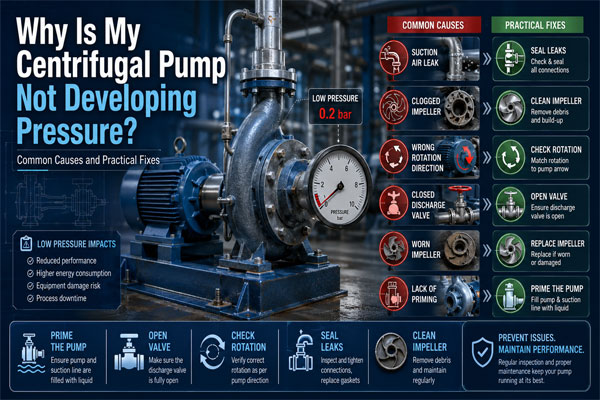
- Wrong Rotation Direction: A 3-phase motor wired the wrong way runs the pump backward. The pump still runs, but pressure is very low — usually 30–50% of rated.
- Air Leak on the Suction Side: Even a small leak at a flange, gasket, or seal lets air in. Air breaks the liquid column, and pressure drops.
- Clogged Strainer or Foot Valve: Blockage on the suction side reduces flow and pressure at the impeller eye.
- Worn Impeller: Cavitation, abrasive liquids, or long service life wear down the vanes. The pump cannot build rated head.
- Worn Wear Rings: Larger clearances between the impeller and casing cause internal leakage. Liquid circulates inside the pump instead of going out the discharge.
- Damaged Mechanical Seal: A leaking seal lets air in (suction side) or liquid out (discharge side), both of which lower pressure.
- System Head Higher Than Pump Capacity: The system may have been modified — a new valve, longer pipe, or higher tank. The pump cannot keep up.
- Speed Too Low (VFD issue): A variable frequency drive set to a low speed reduces pressure. Pressure follows the square of speed.
- Wrong Impeller Diameter: A trimmed or replaced impeller that is too small will not reach the rated head.
- Suction Cavitation: Low NPSHa (often resulting from insufficient NPSH) causes vapor bubbles, which lower the effective flow and head.
Step-by-Step Troubleshooting Guide
Follow these steps in order. Most of the time, the cause is in the first three steps.
Step 1: Check the Rotation Direction
Look at the motor from the coupling end. The shaft should rotate in the direction shown by the arrow on the pump casing. If it is backward, swap any two phases of the 3-phase supply.
Step 2: Check for Air Leaks on the Suction Side
Pour water on the suction flange while the pump is running. If pressure rises, there is an air leak. Use a soap solution on every joint to find bubbles.
Step 3: Check the Strainer and Foot Valve
Open and clean the suction strainer. Check the foot valve for blockage. A clogged strainer is a very common cause.
Step 4: Check the Mechanical Seal
Look for dripping or wet areas around the seal. A leaking seal means you must replace the mechanical seal.
Step 5: Measure the System Head
Read the discharge gauge. Compare to the pump curve at the actual flow. If the curve says the pump can deliver 30 m of head but the gauge shows 18 m, the pump is not performing. Look for internal problems (worn impeller or wear rings).
Step 6: Inspect the Impeller and Wear Rings
Open the pump and check the impeller for pitting, wear, or blockage. Check the clearance between the impeller and the wear ring. If it is more than the maker’s spec, the rings must be replaced.
How Each Problem Is Solved
Here is the problem-and-solution list for the most common pressure issues.
- Problem: Pump runs but discharge pressure is very low.
Solution: Check rotation direction. If backward, swap two phases of the motor supply. - Problem: Pressure rises then drops, with vibration.
Solution: Air is entering the suction line. Tighten flanges, replace gaskets, fix the seal. - Problem: Pressure is low only at high flow.
Solution: Wear rings are worn. Open the pump and replace the wear rings. - Problem: Pressure is low even after cleaning the strainer.
Solution: The impeller may be worn or eroded. Inspect it and replace if needed. - Problem: Pressure was fine last month, low now.
Solution: Something in the system changed — a closed valve, a new fitting, a clogged discharge filter. Check the system, not the pump. - Problem: Pump cannot reach rated head even when new.
Solution: The pump is undersized for the system. You need a larger pump (such as a multistage feed pump), a larger impeller, or higher motor speed.
Quick Symptom-to-Cause Table
| Symptom | Likely Cause | What to Check |
|---|---|---|
| No pressure at all, but the pump runs | Air leak, loss of prime or incorrect rotation | Inspect the suction side and motor wiring |
| Pressure rises briefly and then drops | Suction blockage or vapour formation | Clean the strainer and check NPSH conditions |
| Pressure is approximately half of the rated value | Incorrect rotation or undersized impeller | Check the rotation direction and impeller size |
| Pressure drops after running for some time | Air leak, seal leakage or overheating | Inspect seals, gaskets and bearing temperature |
| Crackling sound with low pressure | Cavitation | Compare NPSHa with NPSHr and check liquid temperature |
| Pressure is normal at low flow but drops at high flow | Worn wear rings or internal leakage | Open the pump and inspect internal clearances |
| Pressure is normal during testing but low in the plant | System head is higher than expected | Check valves, filters and pipe size |
Around 80% of “no pressure” problems are solved by correcting the pump rotation, fixing an air leak or cleaning a clogged strainer. Always check these three points first.
Why a Worn Impeller Causes Low Pressure
The impeller is the heart of the centrifugal pump. It uses vane shape to push liquid outward. When the vanes wear down due to:
- Sand or abrasive particles in the liquid
- Long-term cavitation damage
- Chemical attack on the metal
…the vane shape changes. The pump cannot accelerate the liquid as fast, so the velocity-to-pressure conversion in the volute is weaker. Result: lower discharge pressure at every flow point.
Why Air Leaks Cause Low Pressure
A centrifugal pump needs a solid column of liquid on the suction side. If air enters anywhere from the tank to the pump eye, the liquid column breaks. Air is much lighter than liquid, so the impeller cannot build the same pressure head. The pump may run quietly, but pressure drops, and flow drops with it – a symptom that is often confused with pump cavitation damage.
To find an air leak, you can:
- Pour water on the suction flange and watch the pressure gauge.
- Use a soap solution on every joint and look for bubbles.
- Pressure-test the suction line with air and listen for hissing.
What System Head Has to Do with Pressure
A pump does not create pressure on its own. It only creates the pressure needed to overcome the system head. System head includes:
- Static head (vertical distance)
- Friction loss in pipes
- Friction loss in fittings and valves
- Pressure at the discharge point (e.g., a boiler, a filter)
If the system head rises above the pump’s rated head, the pump cannot keep up. Common reasons are a new control valve, a clogged discharge filter, a higher tank, or a longer pipe run. Always measure the actual system head using a proper pump head calculation before assuming the pump is faulty.
Tools You Need for Troubleshooting
- Pressure gauges on suction and discharge
- Clamp-on ammeter to check motor current
- Tachometer to confirm motor RPM
- Soap solution for air leak tests
- Basic hand tools for strainer and seal work
- Pump curve (from the maker) for comparison
When to Call an Expert
Call Rinku Engineers or request a pump inspection if:
- You have tried the simple steps but pressure is still low.
- You suspect the impeller is worn but need a vibration or performance test.
- You need to choose a bigger impeller, a different pump model, or a polypropylene pump for chemical duties.
- The pump is critical and downtime is costly.
Conclusion
A centrifugal pump not developing pressure is one of the most common problems in any plant. Most of the time, the cause is simple — wrong rotation, an air leak, a clogged strainer, or a worn impeller. By following the steps in this guide, you can find the cause quickly and get the pump back to full pressure without long downtime.
If you go through the basic checks and still cannot solve the issue, the pump may be undersized for the system or the impeller may be too worn. In that case, talk to an expert. Browse our centrifugal process pump catalogue to explore suitable replacements. Rinku Engineers can review your pump curve, check your NPSH, and recommend the right fix — be it a new impeller, new wear rings, or a new pump.
Frequently Asked Questions (FAQs)
The most common reasons are a worn impeller, air leaks on the suction side, a clogged strainer, a wrong rotation direction, a damaged mechanical seal, or the system head is higher than the pump can deliver.
Check the rotation direction, look for air leaks on the suction side, clean the strainer, check the mechanical seal, measure the actual head, and compare it to the pump curve.
Yes. A worn or eroded impeller has lost its vane shape and cannot build rated pressure. The pump must be opened and the impeller replaced.
Yes. Even a small air leak on the suction side breaks the liquid column, drops suction pressure, and prevents the pump from building full discharge pressure.
If the pump runs at full speed, has no air leaks, has a good impeller, and still cannot reach the required pressure, the pump is undersized for the system head. You need a bigger pump or impeller.
Yes. Pressure is proportional to the square of speed. If you cut speed by 20%, pressure drops by about 36%. Always check the VFD setting first.
Check the discharge pressure every shift. Compare the reading to the rated value. A drop of more than 5% is a warning sign that needs investigation.