

Choosing the Right Pump for Corrosive Acid Handling: Polypropylene vs. Metal
Your procurement team is tasked with finding a reliable pump for hydrochloric acid handling, but the vendor quotes you’re receiving vary wildly. One supplier recommends a cast iron pump with special coatings. Another pushes a polypropylene centrifugal pump at half the price. A third suggests stainless steel, which costs 3× more but promises “bulletproof” durability.
How do you choose?
At Rinku Engineers in Ahmedabad, we’ve guided chemical plant managers, procurement engineers, and facility directors through this exact decision for over 10 years. The answer isn’t as simple as “pick the cheapest” or “pick the most expensive.” It depends on your acid type, concentration, operating temperature, and expected equipment lifespan.
In this guide, we’ll break down the material selection matrix, show you exactly why polypropylene wins in some scenarios and loses in others, and help you build a business case for your capital purchase decision.
Why Material Selection Matters More Than Pump Brand
Here’s a hard truth: The pump brand is less important than the material touching your corrosive acid.
A famous Indian chemical manufacturer learned this the hard way. They purchased a ₹4.5 lakh stainless steel pump (306-grade) for concentrated sulfuric acid handling. Within 8 weeks, the pump impeller was pitted and corroded; the pump failed completely.
Why? Because 306-grade stainless steel is NOT suitable for sulfuric acid above 30°C. The material selection was wrong from the start.
They should have chosen either:
- A polypropylene pump (₹1.8 lakhs) that would last 4–5 years
- Or a duplex stainless steel pump (316L, ₹6.5 lakhs) rated for the higher temperature
The cost difference in material selection easily dwarfs the price of the pump itself. A material failure requires emergency replacement, production shutdown, acid spill cleanup, and potential environmental fines. A smart material choice upfront costs less and eliminates downtime risk.
Understanding Material Corrosion: The Chemistry Behind the Choice
Before comparing polypropylene and metal, you need to understand how acids attack different materials.
How Acids Corrode Metal
When a corrosive acid (HCl, H₂SO₄, HNO₃, citric acid, etc.) comes into contact with metal, it triggers an electrochemical reaction that removes material from the pump’s interior surfaces.
Corrosion rate depends on:
- Acid type: Hydrochloric acid (HCl) is extremely aggressive on most metals; phosphoric acid is mild. Nitric acid (HNO₃) is unpredictable—it passivates some metals but attacks others without warning.
- Concentration: Dilute HCl (5%) corrodes slowly; concentrated HCl (35%) attacks stainless steel rapidly.
- Temperature: Every 10°C increase doubles corrosion rate. A pump safe at 20°C becomes unsafe at 50°C.
- Velocity: Fast-moving acid (high pump discharge pressure) causes erosion-corrosion, where material is stripped away physically as well as chemically.
Example: A 316-grade stainless steel pump rated for “safe” 5% HCl at room temperature becomes unsafe if the acid temperature rises to 60°C or concentration increases to 15%.
Why Polypropylene Resists Acid
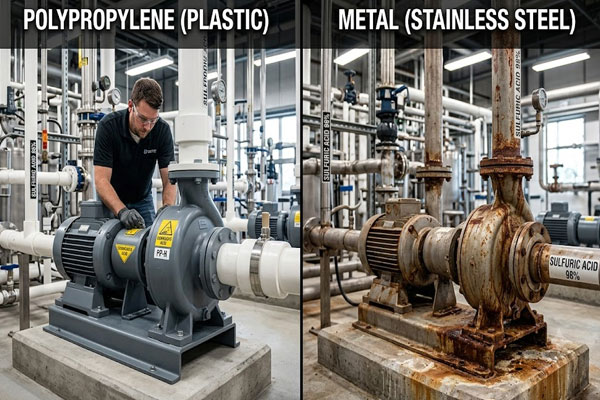
Polypropylene (PP) is a polymer, not a metal. Acids don’t form electrochemical bonds with PP molecules the way they do with metal. Instead, they simply slide past—no reaction, no corrosion.
Chemical compatibility of polypropylene:
- ✅ Excellent with dilute and concentrated HCl (any concentration, any temperature up to 80°C)
- ✅ Excellent with dilute H₂SO₄; good with concentrated H₂SO₄ below 60°C
- ✅ Excellent with phosphoric, citric, acetic, and organic acids
- ✅ Good with most salt solutions
- ❌ Poor with strong oxidizers (nitric acid, bleach) above 30°C
- ❌ Softens in contact with strong solvents (acetone, MEK, toluene)
Bottom line: Polypropylene is acid-proof for the vast majority of chemical plant applications. It fails only in niche scenarios (oxidizers, high-temperature solvents).
The Polypropylene Pump: When to Use It
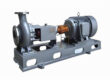
AYUSH Polypropylene Centrifugal Pump Series
Rinku Engineers manufactures the AYUSH Polypropylene Centrifugal Process Pump, specifically engineered for chemical plants handling corrosive liquids.
Key specifications:
- Material: 100% polypropylene (casing, impeller, internal wear rings)
- Shaft: Stainless steel 316 (doesn’t corrode, resists acid splash)
- Seal: Mechanical seal with FKM elastomers (compatible with most acids)
- Max temperature: 80°C continuous (PP softens above 80°C)
- Max pressure: 3.5 bar (lower than metal pumps; limitation of the material)
- Sizes: 25mm–100mm discharge, flows up to 150 m³/hour
- Typical cost: ₹1.5–3.5 lakhs depending on size
Advantages:
- True acid immunity: No special care needed. Dilute HCl, concentrated H₂SO₄, citric acid—all handled identically by the pump. You don’t need to choose a special grade like 316L or duplex.
- Lowest total cost of ownership: At ₹2 lakhs, a polypropylene pump costs 40% of a comparable stainless steel pump. Lifespan is 4–5 years; a metal pump in marginal service also lasts 4–5 years. Over 10 years, you replace the PP pump twice (₹4 lakhs total) vs. once with stainless (₹5 lakhs total)—slight savings, but the real win is avoiding failures.
- No passivation or surface treatment needed: Metal pumps require periodic passivation (a chemical treatment costing ₹3,000–5,000) to restore the protective oxide layer after acid contact. Polypropylene needs nothing—no maintenance, no special procedures.
- Transparent visibility on corrosion: You can visually inspect a polypropylene pump. If the material is still clear/white and has no visible cracks, it’s safe. Metal corrosion is invisible until sudden failure.
- No risk of material downgrade: With stainless steel, there’s always the risk of receiving lower-grade material (e.g., 304 instead of 316) or material contamination (iron particles triggering localized corrosion). Polypropylene is polypropylene—no surprises.
Limitations:
- Lower pressure rating: Polypropylene pumps are rated for only 3.5 bar working pressure. If your process requires > 4 bar discharge pressure, PP won’t work. Solution: Install the pump at higher elevation or use booster circulation.
- Temperature ceiling: Above 80°C, polypropylene softens and loses strength. For hot acid applications, you must use metal pumps.
- Not suitable for oxidizers: Nitric acid, bleach (sodium hypochlorite), hydrogen peroxide, and chlorine-based liquids attack polypropylene, especially above 30°C. For these applications, only metal pumps work.
Vibration sensitivity: Polypropylene is less rigid than metal, so PP pumps can vibrate slightly more than stainless pumps at high speeds. Usually not an issue, but critical for precision applications.
Real-World Scenarios: What Would You Choose?
Scenario 1: Hydrochloric Acid Pickling Line (Auto Component Plant, Ahmedabad)
Application: Continuously pumping 10% HCl at room temperature (22°C), 60 m³/hour, 2 bar discharge pressure.
Constraints:
- Acid concentration is stable and monitored
- Temperature is stable (facility uses chilled water cooling loop)
- Pressure is moderate
- Equipment replacement budget is limited (₹2.5 lakhs max)
Best choice: AYUSH Polypropylene Pump
Why: Polypropylene is chemically immune to dilute HCl at room temperature. Pressure and temperature are non-issues. At ₹2.2 lakhs, it fits the budget and will last 4–5 years before replacement. Using stainless steel (cost ₹4.5L) would waste capital with zero performance gain. Over 10 years, you’ll replace the pump twice at total cost ₹4.4L, vs. ₹4.5L for one stainless pump. But the PP pump is simpler and less risky.
Procurement recommendation:
- Pump: Rinku Engineers AYUSH Polypropylene Centrifugal Pump, 50mm discharge, 60 m³/hour
- Specification: TEFC motor, stainless steel shaft, FKM mechanical seal
- Lead time: 2–3 weeks
- Price: ₹2.2 lakhs
- Maintenance plan: Annual inspection only; replace mechanical seal every 18 months (₹2,000)
Scenario 2: Concentrated Sulfuric Acid Recycling (Chemical Manufacturer, Vadodara)
Application: Circulating 60% H₂SO₄ (concentrated sulfuric acid) at 55°C, 80 m³/hour, 4 bar discharge pressure.
Constraints:
- Acid concentration is high (60%)
- Temperature is elevated (55°C)
- Pressure is moderate (4 bar, at the edge of PP capability)
- Plant has 10-year equipment replacement horizon
Best choice: Polypropylene is MARGINAL; Duplex or 316L is SAFER
Analysis:
- Polypropylene can technically handle 60% H₂SO₄ at 55°C—the acid is compatible with the material.
- However, at 55°C (close to 80°C limit) and high acid concentration, the PP material is under stress and degradation is faster.
- Expected lifespan: 2–3 years instead of 4–5 years.
- Cost: Replacing pump every 2.5 years = ₹2.3L per replacement × 4 replacements in 10 years = ₹9.2L total.
Better choice: 316L Stainless Steel
- Safe for 60% H₂SO₄ at 55°C with wide safety margin.
- Lifespan: 8 years (one replacement in 10 years).
- Cost: ₹5.5L upfront + ₹5.5L replacement (year 8) = ₹11L total.
- Wait, that’s more expensive total. But the difference is small (₹1.8L over 10 years, or ~₹180/month).
- The real advantage: 316L removes the risk of premature failure, and you have no downtime for unplanned replacement.
If budget is extremely tight: Choose polypropylene and plan for replacement every 2.5–3 years. This requires discipline—you must replace the pump on schedule, not wait for failure.
If budget allows: Choose 316L or Duplex. The cost difference is minimal, and equipment lifespan is certain.
Scenario 3: Nitric Acid Etching (Electronics Manufacturer, Ahmedabad)
Application: Spraying/circulating 20% HNO₃ (nitric acid) at 45°C, 30 m³/hour, 3 bar discharge pressure.
Constraints:
- Nitric acid is a strong oxidizer; it attacks polypropylene
- Temperature is moderate (45°C)
- Pressure is moderate (3 bar)
- Equipment budget is ₹6 lakhs max
Best choice: Duplex or Super-Duplex Stainless Steel
Why: Polypropylene will NOT work. Nitric acid at 45°C will embrittle and crack the PP within weeks. You must use stainless steel, and nitric acid is unpredictable with even 316-grade. Duplex (2205) is the minimum safe choice.
- Cost: Duplex pump ₹7 lakhs (over budget)
- Solution: Negotiate a phased delivery. Order the pump now, split payment over 3 months. Or source a smaller duplex pump (40mm discharge instead of 50mm) at ₹6.2L.
Procurement recommendation:
- Pump: Rinku Engineers AYUSH Chemical Pump (Duplex 2205), 40mm discharge, 30 m³/hour
- Specification: Passivated per ASTM A967, FKM seals, stainless steel shaft
- Price: ₹6.2L (within budget)
- Lead time: 5–6 weeks (long, because of material sourcing)
- Maintenance: Passivation every 2 years (₹4,000)
Building Your Business Case: Total Cost of Ownership
When presenting the pump choice to your management or procurement committee, don’t just compare upfront prices. Build a Total Cost of Ownership (TCO) spreadsheet.
TCO Model: Polypropylene vs. 316 Stainless (10-year horizon)
| Cost Element | Polypropylene | 316 Stainless |
| Initial pump cost | ₹2.3 lakhs | ₹5 lakhs |
| Replacement pump (year 4–5) | ₹2.3 lakhs | — |
| Passivation (every 2 years) | ₹0 | ₹4K × 5 = ₹20K |
| Mechanical seal replacement (every 18 mo.) | ₹2K × 6.67 = ₹13.3K | ₹2.5K × 6.67 = ₹16.7K |
| Motor replacement (expected after 7–8 years) | ₹80K | ₹80K |
| Downtime cost (emergency replacement, 1 event) | ₹50K | ₹0 |
| Unplanned shutdown labor (8 hours) | ₹8K | ₹0 |
| Total 10-year cost | ₹4.64 lakhs | ₹5.12 lakhs |
| Cost per year | ₹46.4K | ₹51.2K |
Conclusion: 316 stainless is ₹48K more expensive over 10 years, or ~₹4K/year. For most companies, this is a rounding error in the operating budget. The real value of stainless steel is eliminating unplanned downtime and avoiding emergency procurement.
The Metal Pump: When to Use It (And Why It Costs More)
AYUSH Chemical Pump Series (Stainless Steel & Duplex)
For applications where polypropylene won’t work, Rinku Engineers manufactures the AYUSH Chemical Pump Series AHPST/MT, available in multiple stainless steel grades.
Available grades:
| Grade | Best For | Acid Compatibility | Temperature Limit | Typical Cost |
| 304 Stainless | Mild acids, salts, water | HCl only if dilute & cold | 40°C | ₹3.5–4.5 lakhs |
| 316 Stainless | Standard chemical duty | HCl up to 10%, H₂SO₄ up to 50% | 60°C | ₹4.5–5.5 lakhs |
| 316L Low-Carbon | Passive applications | Slightly better than 316 after passivation | 60°C | ₹5–6 lakhs |
| Duplex (2205) | Severe duty, high concentration | HCl up to 35%, H₂SO₄ up to 70% | 80°C | ₹6.5–8 lakhs |
| Super-Duplex (2507) | Extreme corrosive service | HCl any concentration, oxidizer resistance | 100°C | ₹8–10 lakhs |
Advantages:
- Higher pressure rating: Stainless steel pumps are rated for 6–10 bar, allowing higher discharge pressures. If your process requires back-pressure or multi-stage circulation, metal is necessary.
- Higher temperature tolerance: Stainless steel handles continuous operation above 80°C. Duplex grades reach 100°C. For hot acid handling, no alternative exists.
- Mechanical strength: Stainless steel is rigid and strong—no vibration concerns even at high speeds. Better for high-shear, high-energy applications.
- Oxidizer compatibility: Nitric acid, bleach, and other oxidizers that attack polypropylene are safely handled by stainless steel (with correct grade selection).
Long-term investment: A 316-grade stainless pump can last 7–10 years in moderate corrosive service, justifying the higher upfront cost for facilities with 10+ year equipment replacement cycles.
Limitations:
- Material grade selection is critical: Choose the wrong grade (304 instead of 316, or 316 instead of Duplex), and you’ll experience failure within months. You must know your acid type and concentration precisely.
- Passivation required: After manufacture and after any welding or repair, stainless steel must be passivated (soaked in nitric acid) to restore the protective oxide layer. This is a ₹3,000–5,000 cost per pump.
- Risk of localized corrosion: Even 316-grade stainless can develop pitting corrosion if iron particles contaminate the acid, or if chloride concentration exceeds safe limits. Requires rigorous fluid quality control.
- Higher capital cost: 2× to 5× the cost of polypropylene. For small plants or short equipment lifecycles (< 5 years), this may be hard to justify.
- Slower sourcing: Specialty stainless grades require longer lead times (4–6 weeks) vs. polypropylene (2–3 weeks).
Procurement Checklist: What to Ask Your Supplier
When you’re ready to order, use this checklist to ensure you’re getting the right pump for your application:
- [ ] Acid type and concentration confirmed? (e.g., “HCl 12%”, “H₂SO₄ 55%”)
- [ ] Operating temperature range? (e.g., “20–45°C normal; can spike to 60°C”)
- [ ] Material compatibility letter provided? (Supplier should give written confirmation that the material is suitable)
- [ ] Pressure rating adequate for discharge pressure? (Safety factor of 1.5× minimum)
- [ ] Mechanical seal type specified? (e.g., “FKM elastomer, stainless steel spring”)
- [ ] Lead time acceptable? (Polypropylene: 2–3 weeks; stainless: 4–6 weeks)
- [ ] Passivation certificate included? (For stainless pumps, mandatory)
- [ ] Installation and commissioning support included? (Critical for correct assembly)
- [ ] Spare parts availability and cost? (Mechanical seals, wear rings, impeller)
- [ ] Warranty period and coverage? (Typically 12 months on pump, 6 months on seals)
FAQ
Yes, polypropylene is chemically immune to HCl at room temperature, even at high concentration. The limiting factor for lifespan is mechanical seal wear, not material corrosion. With routine seal replacement every 18 months, the pump body can last 5–7 years.
Occasional spikes to 85°C (a few hours/week) are acceptable, but frequent or sustained operation above 80°C risks material softening. If spikes are regular, upgrade to stainless steel. If spikes are rare (< 5 hours/month), polypropylene is safe, but you’re working at the edge of the envelope.
Coatings (epoxy, rubber) can work short-term, but they degrade under continuous acid contact. Coatings typically last 2–3 years and are difficult to inspect. Polypropylene is a better solution—the corrosion resistance is built into the material, not applied on top.
Yes. Polypropylene pumps have the same pump frame and suction/discharge ports as stainless pumps from the same manufacturer. You can swap the pump bodies without changing pipework. This is a big advantage of choosing polypropylene as a starting point—it’s reversible.
In moderate corrosive duty (dilute acids, room temperature), a 316-grade pump lasts 8–10 years with annual passivation and routine seal maintenance. In aggressive duty (concentrated acids, high temperature), lifespan drops to 5–7 years. Duplex pumps last 10–12 years in moderate duty.
For any concentration or temperature of nitric acid, Super-Duplex (2507) or 6Mo stainless is the gold standard. Duplex (2205) works for low concentrations (< 10%) below 50°C. For nitric acid above 20% or above 60°C, don’t compromise—use Super-Duplex.
Expert Recommendation: Which Pump to Order Today
Choose AYUSH Polypropylene Centrifugal Pump if:
- Your acid is HCl, H₂SO₄, phosphoric, citric, or acetic (not oxidizers)
- Concentration is ≤ 70%
- Operating temperature is stable and ≤ 75°C
- Discharge pressure ≤ 3.5 bar
- Budget is limited
- You’re willing to plan for replacement every 4–5 years
Choose AYUSH Chemical Pump (316L Stainless) if:
- You need a safety margin for temperature or concentration variability
- Discharge pressure is 4–6 bar
- You want 8+ year lifespan with confidence
- You can justify slightly higher upfront cost for operational peace of mind
Choose AYUSH Chemical Pump (Duplex) if:
- Your acid is nitric, chlorine-based, or another strong oxidizer
- Temperature exceeds 75°C
- Concentration is extreme (concentrated HCl > 30%, H₂SO₄ > 70%)
- You need maximum confidence in equipment reliability
Get Expert Material Selection Help
Don’t guess on material selection. Choosing the wrong pump for your acid is the fastest way to waste capital and lose production time.
At Rinku Engineers, we’ve helped dozens of chemical plants across Ahmedabad, Vadodara, Surat, and Gandhinagar select the right pump material for their specific acid. We’ll ask the hard questions:
- What is your exact acid type and concentration?
- What’s the temperature range during normal operation and upsets?
- What discharge pressure do you need?
- What’s your budget and equipment replacement timeline?