

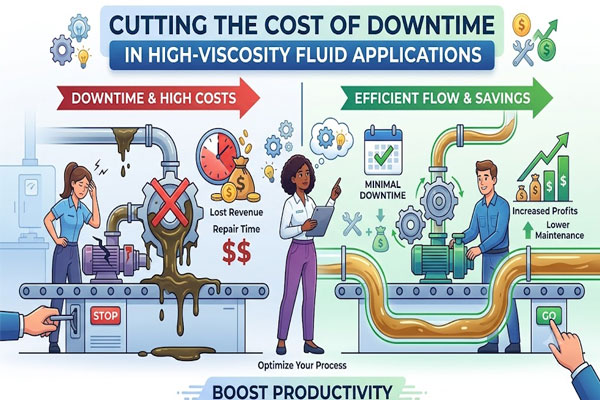
Cutting the Cost of Downtime in High-Viscosity Fluid Applications
A plant manager at a lubricating oil manufacturer in Ahmedabad called us in a panic. “Our centrifugal pump failed again. This is the third time in 18 months. We’ve lost ₹2.2 lakhs in lost production this year alone.”
When we inspected the pump, the diagnosis was immediate: The facility was using a centrifugal pump to handle oil with 900 cSt viscosity. Centrifugal pumps are designed for water-like fluids (1–50 cSt). Trying to pump oil 18× thicker than water causes cavitation, vapor binding, and mechanical seal failure.
The solution was straightforward: Replace with a positive displacement pump (rotary gear pump or lobe pump). The new pump cost ₹3.8 lakhs—but it eliminated downtime and paid for itself in reduced losses within 14 months.
This is a story we see repeated across manufacturing facilities handling thick fluids: Wrong pump selection costs more in downtime than the price difference of the right pump. In this guide, we’ll show you exactly how to calculate the hidden costs of downtime and build a business case for upgrading to the right pump.
The Hidden Cost of Downtime: What You’re Really Losing
Most plant managers know the direct cost of downtime: Lost production = Lost revenue. But the true cost is much higher because downtime triggers cascading losses.
Direct Downtime Costs
For a facility running continuously (24/7 operation), every hour of unplanned downtime is pure revenue loss.
Example calculation:
- Plant throughput: 10,000 liters/hour
- Product value: ₹200/liter (typical for industrial fluids—lubricants, hydraulic oil, solvents)
- Hourly revenue: 10,000 L × ₹200 = ₹20 lakhs/hour
- Unplanned downtime: 8 hours (pump failure + spare parts wait + replacement + restart)
- Direct revenue loss: ₹20L × 8 hours = ₹160 lakhs lost
That’s for a single failure. If your pump fails 3 times/year, you’re losing ₹480 lakhs annually to downtime alone.
Indirect Downtime Costs
Beyond lost production revenue, downtime triggers:
- Emergency procurement costs: When the pump fails on a weekend or holiday, you’re paying premium fees for emergency parts delivery (₹10K–30K per incident).
- Overtime labor: Maintenance staff work nights/weekends to restore equipment, triggering overtime pay (₹5K–15K per incident).
- Spillage & waste: During pump failure and replacement, some product remains in lines and is lost when you need to break connections. Small spill = ₹5K–20K wasted product.
- Production ramp-up penalty: After restart, your production line doesn’t immediately reach full capacity. Startup takes 30–60 minutes, during which output is 30–50% of normal. That’s another ₹3–10L in lost production per incident.
- Regulatory & compliance costs: Some industries (pharmaceutical, food, chemicals) require shutdown documentation, cleaning protocols, and re-qualification before restarting. This can add 4–8 hours to the total shutdown time.
- Customer relationship damage: If you miss a delivery commitment due to pump failure, you risk losing the customer to competitors. Long-term customer value loss: ₹50–200 lakhs.
Real-World Total Cost of Pump Failure
Using the oil manufacturer example above:
| Cost Category | Cost per Failure | 3 Failures/Year |
| Direct revenue loss (8 hours × ₹20L/hour) | ₹160 lakhs | ₹480 lakhs |
| Emergency procurement & spare parts | ₹25K | ₹75K |
| Overtime labor (16 hours × ₹500/hour) | ₹8K | ₹24K |
| Product spillage/waste | ₹15K | ₹45K |
| Production ramp-up penalty (4 hours × ₹10L/hour) | ₹40L | ₹120 lakhs |
| Regulatory/compliance shutdown time (4 hours) | ₹20L | ₹60 lakhs |
| Total cost per failure cycle | ₹220.1 lakhs | ₹660.1 lakhs/year |
At this rate, the facility is losing over half a crore rupees annually due to pump failures caused by wrong equipment selection.
A ₹3.8 lakh pump upgrade pays for itself in 7 days of prevented downtime.
Why Centrifugal Pumps Fail on Thick Fluids
To understand the solution, you first need to understand why centrifugal pumps fail on high-viscosity applications.
How Centrifugal Pumps Work
A centrifugal pump uses high-speed rotation (typically 1450–2900 RPM) to spin an impeller that creates centrifugal force, which pushes fluid outward into the casing and toward the discharge.
Energy transfer formula: Head (pressure) = (D × RPM)² / constant
For water (1 cSt), this works perfectly. The impeller spin generates sufficient pressure to move water against gravity and friction losses.
The Problem: Viscosity Creates Drag
When you introduce a thick fluid (500–5000 cSt), viscous drag increases exponentially.
What happens:
- Reduced actual flow: The impeller still spins at full speed, but the thick fluid resists acceleration. Actual flow drops to 30–50% of rated capacity. You get ₹10L worth of output from a pump that should deliver ₹20L.
- Heat generation: The friction between the high-speed impeller and the thick fluid creates enormous heat. Outlet temperature can rise 20–40°C above inlet temperature. This heat degrades the product (if it’s temperature-sensitive) and damages elastomer seals.
- Cavitation: At high speeds with thick fluids, the pressure at the impeller eye drops below the vapor pressure of the fluid. Vapor bubbles form and collapse violently, eroding the impeller and creating shock waves that damage the mechanical seal and bearings.
- Mechanical seal failure: The seal is designed for centrifugal pump duty. When cavitation and high heat strike, the seal faces separate, elastomers shrink, and the seal fails within weeks or months instead of years.
- Bearing overload: The thick fluid creates drag forces that load the motor bearings beyond design spec. Bearing temperature rises, lubrication breaks down, and the bearing seizes within months.
Result: The centrifugal pump designed for 2-year lifespan fails after 3–6 months when handling thick fluids.
Positive Displacement Pumps: The Right Solution
Positive displacement (PD) pumps work on a completely different principle. Instead of using centrifugal force, they use mechanical displacement to move a fixed volume of fluid with each rotation.
How Rotary Gear Pumps Work
An external gear pump consists of two interlocking gears (like meshing bicycle sprockets). As the gears rotate, the space between them increases on the inlet side and decreases on the discharge side. Fluid is trapped in the tooth spaces and pushed outward by the rotating gears.
Key advantage: The pump doesn’t care about viscosity. A fixed volume is trapped and displaced per revolution, whether the fluid is water or 5000 cSt oil. The pressure rise depends on how hard you push against the discharge resistance, not on fluid properties.
Gear pump characteristics:
- Viscosity tolerance: Works safely with fluids 1–1000 cSt (some models up to 5000 cSt)
- Self-priming: Pumps thick, degassed fluids without cavitation
- Constant displacement: Flow = gear volume × RPM (predictable, not speed-dependent like centrifugal)
- Pressure capability: 50–210 bar (centrifugal maxes out at ~10 bar)
- Temperature rise: Minimal if relief valve is set correctly (thick fluid, lower flow = lower heat)
How Lobe Pumps (Rotary Twin-Lobe) Work
A lobe pump uses two rotating lobes (shaped like figure-eights) that trap and move fluid. Similar displacement principle to gear pumps, but:
Lobe pump advantages:
- Gentler on product: Lobes have less shear than gear teeth, so fragile products (food, pharmaceuticals, emulsions) are handled more gently
- Lower noise: Lobe contact is softer than gear mesh, so noise is lower
- Better for solids: Can handle small particles without grinding them up
Lobe pump disadvantages:
- Lower pressure: Max 3–5 bar (vs. gear pumps at 50–210 bar)
- Lower speed: Typical 40–300 RPM (vs. gear pumps at 500–2000 RPM)
When to Choose Each Pump Type
Choose Rotary Gear Pump (AYUSH ROTARY GEAR PUMP) if:
- Viscosity is high (500–1000 cSt or higher)
- Discharge pressure is needed (2–210 bar)
- Reliability is critical (any downtime is unacceptable)
- Product is robust (doesn’t shear or degrade under pressure)
- You need consistent, predictable flow (displacement is independent of viscosity or discharge pressure)
Typical applications:
- Lubricating oil circulation systems
- Hydraulic fluid transfer (filling, sampling, circulation)
- Heavy fuel oil pumping
- Bitumen/asphalt handling
- Coupling fluid circulation in industrial clutches
Rinku Engineers AYUSH Rotary Gear Pump specs:
- Sizes: 0.5–150 L/minute
- Viscosity range: 2–1000 cSt (safe, reliable performance)
- Pressure rating: 3–210 bar (depends on model)
- Shaft options: Stainless steel (corrosive service), standard steel (normal service)
- Seals: FKM (standard), Viton (oil-resistant)
- Material: Cast iron or ductile iron (standard), stainless steel (premium)
- Price range: ₹1.5–6 lakhs depending on flow/pressure rating
Choose Lobe Pump (AYUSH LOBE PUMP) if:
- Viscosity is high, but shear sensitivity is critical
- Gentle handling of product is important (pharmaceuticals, food, emulsions)
- Discharge pressure is low (typically 3–5 bar max)
- Noise must be minimized (lobes run quieter than gear teeth)
- Low-temperature rise is needed (sensitive products)
Typical applications:
- Pharmaceutical gel transfer
- Cosmetic cream/lotion pumping
- Food product circulation (purees, pastes, sauces)
- Paint & coating circulation
- Water/sewage treatment (low-shear slurry)
Rinku Engineers AYUSH Lobe Pump specs:
- Sizes: 0.5–200 L/minute
- Viscosity range: 1–1000 cSt (gentle treatment across range)
- Pressure rating: 3–5 bar (typical); 10 bar (heavy-duty models)
- Shaft options: Stainless steel, standard steel
- Material: Cast iron, ductile iron, or 316 stainless (for corrosive service)
- Speed: 40–300 RPM (low, gentle)
- Price range: ₹1.8–5 lakhs depending on size and pressure
The ROI Case: Centrifugal vs. Gear Pump
Let’s build a real comparison for the oil manufacturer scenario.
Scenario: Industrial Lubricating Oil Circulation
Application specs:
- Flow requirement: 500 liters/hour
- Fluid: ISO 46 hydraulic oil, 900 cSt at 40°C
- Discharge pressure: 3 bar (circulation, not high-pressure)
- Operating mode: Continuous, 24/7 × 350 days/year = 8,400 hours/year
- Expected equipment life: 5 years
Option A: Centrifugal Pump (Current Setup – Failing)
Equipment cost:
- Pump: ₹2.2 lakhs
- Installation: ₹20K
Operating & failure costs over 5 years:
| Year | Failure Events | Downtime Hours/Event | Cost per Event | Annual Cost |
| 1 | 1 | 8 | ₹220L | ₹220L |
| 2 | 1 | 8 | ₹220L | ₹220L |
| 3 | 1 | 8 | ₹220L | ₹220L |
| 4 | 1 | 8 | ₹220L | ₹220L |
| 5 | 2 | 8 | ₹220L each | ₹440L |
5-year totals:
- Equipment cost: ₹2.4L
- Downtime losses: ₹1,320L
- Total 5-year cost: ₹1,322.4L
- Annual average cost: ₹264.5L
Option B: Rotary Gear Pump (Recommended Solution)
Equipment cost:
- Pump: ₹3.8 lakhs (AYUSH Rotary Gear Pump, 500 L/hr, 3 bar)
- Installation: ₹25K
- Total upfront: ₹4.05L (only ₹1.65L more than centrifugal)
Operating & failure costs over 5 years:
| Year | Failure Events | Maintenance | Annual Cost |
| 1–5 | 0 (normal operation) | Seal replacement annually ₹5K; bearing inspection ₹3K | ₹8K/year |
5-year totals:
- Equipment cost: ₹4.05L
- Maintenance (seals, inspection): ₹40K
- Downtime losses: ₹0 (pump is reliable, no unplanned failures)
- Total 5-year cost: ₹4.45L
- Annual average cost: ₹89K
The ROI Comparison
| Metric | Centrifugal Pump | Gear Pump | Difference |
| 5-year total cost | ₹1,322.4L | ₹4.45L | Gear pump is ₹1,318L cheaper |
| Annual cost | ₹264.5L | ₹89K | Save ₹264.4L/year |
| Payback period | — | 6 days (₹1.65L extra cost ÷ ₹264.4L/year savings) |
The gear pump pays for itself in less than a week of prevented downtime.
Even if the oil manufacturer had chosen the gear pump from the start, the upfront cost difference of ₹1.65L would have been recovered in just 2.3 days of downtime avoidance.
Comparing Pump Types for High-Viscosity Applications
Centrifugal Pump (Wrong Choice)
| Property | Performance on Thick Fluid |
| Actual capacity | 30–50% of rated (starved) |
| Heat generation | Extreme (ΔT = 20–40°C) |
| Cavitation risk | Very high |
| Mechanical seal life | 3–6 months (failure) |
| Bearing life | 6–12 months (overload) |
| Typical failure mode | Seal failure → bearing seizure → total pump destruction |
| Lifespan in thick fluid service | 3–6 months (unacceptable) |
| Why people choose it anyway | Lower upfront cost; don’t realize it won’t work until it fails |
Rotary Gear Pump (Right Choice for High Pressure)
| Property | Performance on Thick Fluid |
| Actual capacity | 95%+ of rated (full displacement) |
| Heat generation | Moderate (ΔT = 5–10°C typical) |
| Cavitation risk | None (self-priming) |
| Mechanical seal life | 3–5 years (normal) |
| Bearing life | 4–7 years (normal) |
| Typical failure mode | Slow wear; predictable maintenance |
| Lifespan in thick fluid service | 4–7 years (acceptable, planned replacement) |
| Pressure capability | 50–210 bar (excellent for back-pressure applications) |
Lobe Pump (Right Choice for Gentleness)
| Property | Performance on Thick Fluid |
| Actual capacity | 90–98% of rated (good displacement) |
| Heat generation | Low (ΔT = 2–5°C) |
| Cavitation risk | None (self-priming) |
| Mechanical seal life | 3–5 years (normal) |
| Bearing life | 4–7 years (normal) |
| Typical failure mode | Slow wear; predictable |
| Lifespan in thick fluid service | 4–7 years (acceptable) |
| Pressure capability | 3–5 bar (limited for back-pressure) |
| Product shear | Minimal (safe for fragile products) |
FAQ
Yes, absolutely. Rinku Engineers gear pumps are rated up to 1000 cSt standard and can handle brief exposures to 2000 cSt. At 2000 cSt, flow rate will be near the low end, and heat generation will be modest (if you don’t exceed 5 bar discharge pressure). For continuous duty at 2000 cSt, confirm with the supplier that pressure is kept low (≤ 3 bar) to avoid overheating.
For high-viscosity service, routine maintenance includes:
- Every 6 months: Check oil level in pump case (if self-contained)
- Annually: Replace mechanical seal (₹3K–5K labor)
- Every 2 years: Inspect bearings and gears for wear (₹2K inspection cost)
- Every 4–5 years: Major overhaul (new seals, new bearings, ₹30K–50K)
This is far less costly than waiting for a failure and then doing emergency replacement.
Lobe pumps are rated for 3–5 bar maximum. If you need discharge pressure above 5 bar, use a gear pump instead. Exceeding rated pressure on a lobe pump will cause leakage and seal failure.
Gear pumps are typically 75–85 dB (louder); lobe pumps are 65–75 dB (quieter). If noise is a concern, lobe pump is better. If pressure is needed, gear pump is the only choice.
Absolutely. In the scenario above, the extra cost is recovered in 0.9 days of prevented downtime. Even if your facility experiences only one failure per year (instead of three), the extra cost is recovered in ~5 days. And the gear pump will last 4–5 years vs. 3–6 months for the centrifugal pump on thick fluid.
Most likely yes. Gear and lobe pumps have standard flange sizes that match most centrifugal pump installations. However, confirm suction and discharge port sizes and flange patterns with your supplier before ordering. Some changes (like relief valve installation) may be needed.