


Lobe Pump Price in India Buying Guide
The lobe pump price in India is only one part of a good buying decision. A pump that costs less may still be a poor choice if it damages your product, takes too long to clean or needs extra parts before it can run. For buyers handling cream, sauces, shampoo or other thick liquids, the right fit matters as much as the amount on the quotation.
Start with what you need to move, how fast it must move and how you will clean the line. Then compare pumps built for the same job. This guide explains approximate prices, the features that affect cost and the questions to ask before placing an order. You will also find a simple quote checklist to help you discuss your needs with a supplier and avoid paying for a package that leaves out essential items. A clear brief also makes quotes easier to compare.
Lobe Pump Price in India and What Your Budget Covers
As a rough starting point, selected Indian supplier listings advertise lobe pumps at approximately ₹75,000 to ₹1,25,000 per unit. These are different models with different supply terms. This sample is not the full market range or a Rinku Engineers quotation. Larger or more specialised packages may cost more.
Treat the range as an early planning aid. Ask for a written quote based on your product, flow, pressure and cleaning needs. Confirm whether tax, freight, installation and the drive are included.
| What you are comparing | What to confirm before budgeting |
|---|---|
| Pump without a drive | Whether the motor, gearbox and coupling cost extra |
| Complete mounted unit | Motor, drive, base, guards and controls included |
| Hygienic configuration | Contact materials, finish, seals and cleaning documents |
| Custom package | Trolley, heating jacket, special inlet or control options |
Approximate advertised examples checked in October 2026. Request current prices before ordering.
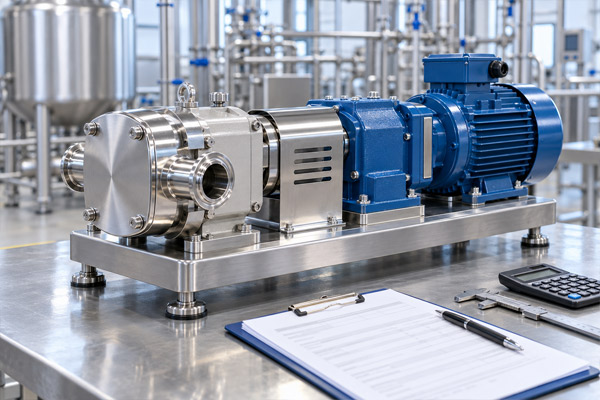
Check the selected model and its supply scope before approving the purchase.
Before You Buy a Lobe Pump Match It to Your Product
A rotary lobe pump moves liquid through spaces between rotating lobes and the casing. It is a positive displacement pump, meaning each rotation moves a set volume in theory. Actual output depends on the liquid and operating conditions.
When you buy a lobe pump, start with these details:
- Product: Name, ingredients and any solid pieces.
- Thickness: Viscosity at the actual pumping temperature.
- Flow: Litres per minute or per hour needed.
- Pressure: Resistance from pipes, valves and connected equipment.
- Running time: Batch transfer or continuous operation.
Low shear means gentler handling, but it does not guarantee that every product will stay unchanged. Speed, lobe shape and particle size still matter. For delicate products, ask whether a sample trial is available before ordering.
What Changes a Sanitary Lobe Pump Price
A sanitary lobe pump price depends on more than a stainless steel body. The design must suit the product and the way you clean it.
Contact materials and seals
Ask which metal grade is used for every part that touches the product. Also check the seal faces and rubber parts. A stainless steel lobe pump supplier should confirm that these materials suit both your liquid and your cleaning chemicals.
Finish and cleaning access
Check the internal surface finish, drainability and access for inspection. Cleaning in place, or CIP, means cleaning without taking the pump apart. Ask for the model’s cleaning instructions and limits. A shiny outer surface tells you little about internal hygiene.
Drive and speed control
Thick products may need a different speed and drive arrangement from thin liquids. A variable frequency drive, or VFD, can help adjust speed within approved limits. Ask the supplier to explain the proposed setup and include its cost in the quote.
Choosing a Lobe Pump for Food Processing and Cosmetics
Buying a lobe pump for food processing starts with the result you need after transfer. The same applies to creams, gels and personal care products.
| Product or process | Problem to avoid | What to discuss with the supplier |
|---|---|---|
| Cream or lotion | A change in texture | Suitable speed and a product trial |
| Sauce with soft pieces | Damaged pieces or blockage | Largest particle size and lobe design |
| Thick paste | Poor flow into the pump | Inlet size, tank position and feed method |
| Frequent product changes | Residue between batches | Cleaning access and a verified cleaning method |
| Product that thickens when cool | Difficult starts | Lowest operating temperature and any heating needs |
For example, a lotion maker may want faster transfer. Simply increasing speed may harm texture or expose a poor inlet arrangement. Share the batch size and target transfer time so the supplier can review the whole duty.
What a Rotary Lobe Pump Quotation Should Include
A useful rotary lobe pump quotation shows exactly what the supplier has selected and why. Send the same requirement sheet to each supplier so you can compare offers fairly.
Ask for:
- Model, flow, pressure, speed and operating temperature.
- Product viscosity used for the selection.
- Contact materials, seal type and connection sizes.
- Motor, gearbox, base, guards and controls included.
- Required pressure protection and who supplies it.
- Cleaning instructions, drawings and relevant documents.
- Delivery time, warranty terms and spare part availability.
- Tax, freight, installation costs and quotation validity.
Check pressure protection before installation. A positive displacement pump needs suitable protection against excessive pressure if its outlet becomes blocked. Ask the supplier to specify the arrangement for your system.
If hygiene certificates are required, request documents that cover the quoted model and configuration. Do not rely on a general brochure claim.
Avoid Hidden Costs When Buying a Lobe Pump
The lowest quotation can become expensive if important items are missing. Look at the cost of keeping the line running, too.
Problem: The pump delivers less than expected. Ask the supplier to review the inlet pipe, tank level, liquid temperature and viscosity. A larger motor alone may not fix poor feeding.
Problem: Seals need frequent replacement. Review the seal selection, cleaning process and operating conditions. Confirm the dry-running limits; do not assume every lobe pump can run empty.
Problem: Cleaning delays the next batch. Check how the pump is opened, drained and cleaned before purchase. Ask your production team to review the proposed method.
Request spare seal prices and lead times with the main quote. Also agree on how flow and product quality will be checked during acceptance.
Request a Lobe Pump Quotation From Rinku Engineers
If you are looking for a lobe pump manufacturer in Ahmedabad, explore the Rinku Engineers lobe pump range. Share your process details to discuss a suitable configuration.
Use this short enquiry format:
We need a lobe pump for our product. Please quote for the required flow and pressure at our operating temperature. We will share viscosity, particle size, pipe details and cleaning needs. Please list the complete supply scope, exclusions, delivery time and warranty terms.
Send your lobe pump enquiry with these details to make the quotation more useful.
Conclusion
Use the lobe pump price in India as a starting point, then compare suitability, cleaning needs and the complete package. A clear quotation helps you understand what you are buying. Confirm the duty and supply scope before placing the order.
FAQ’s
Selected advertised examples fall around ₹75,000 to ₹1,25,000 per unit. This is a limited sample, not a fixed market range. Your selected model, drive, materials and options will determine the quotation.
It may or may not. Ask for separate confirmation of the motor, gearbox, coupling, base, guards and controls. Compare complete packages with the same scope.
Yes, suitable models can handle thick products. Share viscosity at pumping temperature and your tank layout. The supplier must check that the product can reach the inlet at the required rate.
Check contact materials, seals, internal finish, drainability and cleaning instructions. Request any hygiene documents your process requires for the exact model being offered.
This depends on the model and cleaning duty. Ask the supplier to confirm cleaning flow, temperature, chemicals and operating limits. Check whether your system needs a separate cleaning pump.
Choose based on the product, cleaning chemicals and temperature. Ask for written material compatibility confirmation. The grade alone does not confirm that the full pump suits your process.
Send the product name, viscosity, temperature, flow, pressure, particle details and pipe layout. Include cleaning needs, power supply and delivery location. Mention whether you need a complete mounted unit.