


The Role of Mechanical Seals in Industrial Fluid Management
Industrial fluid management relies heavily on securing liquids safely inside pipelines and equipment. Centrifugal pumps move billions of liters of water, harsh chemicals, and thick slurry every single day across the globe. The critical junction where the stationary pump casing meets the rapidly rotating shaft is where most engineering problems begin. Historically, operators packed these gaps with braided ropes, but modern manufacturing demands absolute precision, environmental safety, and zero leakage.
This is exactly where the mechanical seal becomes the most important accessory in your processing plant. Understanding the different seal designs, how they operate, and which specific model fits your application is vital. A mismatch leads to sudden seal failure, toxic chemical spills, burned electric motors, and massive financial losses due to unplanned plant downtime.
Whether you manage a municipal wastewater facility, a chemical processing unit, or a food production plant, selecting the correct sealing technology ensures continuous production. This guide explains the technical differences between various seals and provides practical advice to help industrial buyers make an informed purchasing decision.
What is a mechanical seal?
A mechanical seal is an advanced engineering component used to contain fluid within a vessel, usually a centrifugal pump or industrial mixer, where a rotating metal shaft passes through a stationary housing. Instead of physically squeezing the shaft like old fashioned gland packing ropes, a mechanical seal creates a highly controlled, microscopic restriction path. This path is so incredibly narrow that the liquid cannot easily escape, yet it allows the steel shaft to spin freely with minimal mechanical friction. The ultimate goal of this device is to completely prevent the process fluid from leaking into the outside environment while keeping contaminants out of the pump interior.
Main components of a mechanical seal
Despite their complex function, almost all standard mechanical seals share four primary structural elements.
How does a mechanical seal prevent pump leakage?
The secret to a successful mechanical seal lies in the precise interaction between the rotating and stationary faces. The metal loading mechanism pushes these two incredibly flat surfaces together. However, they do not run completely dry.
As the pump operates, a tiny, microscopic amount of the process liquid forces its way between the two faces. This fluid creates a highly specialized fluid film. This thin film serves three critical purposes: it lubricates the spinning faces, it cools the excessive heat generated by mechanical friction, and it acts as a physical barrier. Because the gap is so tight, the liquid in this fluid film typically evaporates into an invisible vapor before it can emerge on the atmospheric side of the pump. The result is a smooth, frictionless operation with no visible liquid leakage.
What is a multi spring mechanical seal?
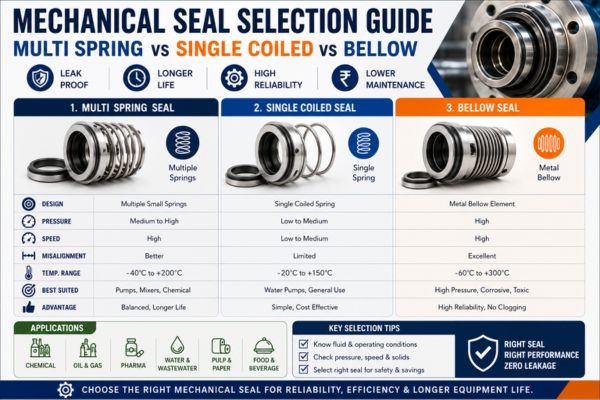
A Multi Spring Mechanical Seal features several small coil springs arranged evenly around the entire circumference of the seal face. This advanced design provides exceptionally uniform mechanical loading across the sealing rings. By distributing the pressure evenly through multiple small contact points, the seal faces are pressed together with equal force at every single location. Because the springs are small and compactly arranged, these seals have a very slim profile, making them ideal for modern compact pumps where internal space is strictly limited.
Benefits, limitations and applications of multi spring seals
The primary benefit of this design is the perfectly even face loading, which prevents uneven wear and extends the overall lifespan of the seal faces. The lightweight springs also respond very quickly to slight shaft vibrations, keeping the seal faces closed during minor alignment shifts.
The main limitation is that the small coil springs can easily trap dirt, suspended solid particles, or crystallizing chemicals. If the springs become clogged with debris, they cannot push the faces together, resulting in immediate leakage.
These seals perform exceptionally well in applications involving clear water, light chemical processing, volatile pharmaceutical solvents, and clean food grade liquids where there are no abrasive solids to jam the delicate springs.
What is a single coiled mechanical seal?
A Single Coiled Mechanical Seal uses one large, heavy duty wire spring wrapped directly around the main shaft to provide the necessary closing force. Unlike the multi spring design, this single robust spring is exposed and highly visible. These seals are traditionally engineered for aggressive and heavy industrial duties where delicate components would fail.
Benefits, limitations and applications of single coiled seals
The greatest advantage of a single coiled design is its incredible resistance to clogging. Because the spring wire is thick and the coils are spaced far apart, heavy sludge, mud, and thick liquids simply wash through the spring without jamming it. It is effectively a self cleaning mechanism.
The primary limitation is that a single spring does not provide perfectly uniform pressure around the entire seal face. Additionally, the spring must be wound in a specific direction matching the shaft rotation. If the pump runs in reverse, the spring will unwind and break.
These robust seals are the absolute standard for heavy sewage treatment plants, paper and pulp mills, sugar factory syrup transfer, and general effluent treatment facilities.
What is a bellow mechanical seal?
A Bellow Mechanical Seal completely eliminates the sliding secondary O rings and traditional coil springs. Instead, it utilizes a flexible, accordion shaped tube called a bellow. As the seal faces wear down, this flexible bellow simply expands to keep the faces pushed together. The bellow itself can be manufactured from welded metal alloys, flexible rubber elastomers, or highly resistant Teflon materials.
Benefits, limitations and applications of bellow seals
The most significant benefit of this technology is the complete elimination of sliding elastomers. In traditional seals, the O ring must slide along the shaft to maintain pressure, which eventually causes severe shaft fretting and metal damage. A bellow seal does not slide, completely protecting the pump shaft. Furthermore, metal bellows can withstand extreme temperatures that would instantly melt standard rubber components.
The limitation is the higher initial purchase price and the fragile nature of metal bellows, which require very careful handling during installation to prevent bending the thin metal leaves.
Detailed comparison of all three seal types
Understanding how these technologies compare directly helps in selecting the perfect unit for your facility.
| Design Feature | Multi Spring Mechanical Seal | Single Coiled Mechanical Seal | Bellow Mechanical Seal |
|---|---|---|---|
| Spring Design | Multiple small coil springs | One large thick wire spring | Flexible accordion tube |
| Clogging Risk | High risk in dirty liquids | Very low risk of clogging | No small springs to clog |
| Space Required | Compact and requires minimal space | Requires substantial axial space | Moderate space requirement |
| Best Fluid Type | Clean liquids and solvents | Thick sludge and sewage | Extreme temperatures and acids |
| Face Loading | Exceptionally even pressure | Moderately even pressure | Perfectly even pressure |
| Shaft Wear | Can cause slight fretting over time | Can cause slight fretting over time | Eliminates shaft fretting entirely |
How liquid type affects seal selection
The process fluid is the single most important factor when choosing sealing equipment. Clear liquids like municipal drinking water provide excellent lubrication and cooling, allowing you to use almost any standard design. However, as the liquid changes, the engineering requirements shift drastically.
Seal selection for acids, chemicals, slurry, sewage, oils, food products and clean water
When pumping concentrated inorganic acids, standard stainless steel components will dissolve rapidly. You must select seals constructed with high grade alloys or pure Teflon components to survive the chemical attack. For abrasive slurry and raw sewage, the fluid contains sharp rocks and sand that will scratch soft seal faces. You must use extremely hard silicon carbide faces paired with a single coiled or bellow design to prevent jamming.
For lubricating oils, standard faces work well, but you must ensure the rubber elastomers are made of Viton, as oil will rapidly degrade standard EPDM rubber. In the food and beverage industry, seals must be manufactured using safe, sterile, and FDA approved materials that can withstand daily steam cleaning procedures without warping.
Importance of pressure, temperature, shaft speed and viscosity
Final seal selection absolutely depends on actual operating conditions inside your plant.
High internal pump pressure attempts to blow the seal faces apart, requiring specialized heavy duty balancing. Extreme liquid temperature affects the fluid film between the seal faces; if the liquid is too hot, it will vaporize instantly, causing the seal faces to run dry and shatter.
Shaft rotational speed dictates how much frictional heat is generated. High speed boiler feed pumps require specialized materials that can quickly dissipate intense thermal energy. Viscosity, which is the thickness of the liquid, changes the entire dynamic. Pumping thick molasses requires a robust single spring design because a delicate multi spring setup will quickly become glued together by the sticky fluid.
Seal face and elastomer material considerations
Choosing the correct construction material prevents premature degradation.
For the rigid seal faces, Carbon Graphite is excellent for clean water because it is naturally self lubricating. Ceramic is a cost effective option for light chemicals. Silicon Carbide and Tungsten Carbide are premium, diamond hard materials specifically required for highly abrasive slurries and high pressure environments.
For the flexible elastomers, EPDM is perfect for hot water and steam but will dissolve if exposed to petroleum oils. Viton is excellent for oils and high temperatures but fails in steam. Pure PTFE is universally chemical resistant, making it mandatory for aggressive chemical plants and hazardous solvents.
Balanced and unbalanced seal concepts explained simply
When a pump operates, the pressurized liquid inside the casing pushes aggressively against the mechanical seal.
An unbalanced seal takes the full force of this internal hydraulic pressure. This high pressure forces the seal faces together very tightly. While this prevents leaks, it creates massive friction, extreme heat, and rapid wear. Unbalanced seals are strictly limited to low pressure applications.
A balanced seal features a specialized structural design, often requiring a slightly stepped shaft. This geometry manipulates the internal fluid pressure, forcing the fluid to push in opposing directions. This balancing act significantly reduces the total closing force on the seal faces. The result is lower friction, reduced heat generation, and the ability to safely handle extremely high pressure industrial applications.
Common causes of mechanical seal failure
Even premium equipment will fail if operated outside its intended limits. The most frequent cause of failure is dry running. If the pump loses its liquid supply even for a few seconds, the lubricating fluid film disappears, the faces overheat, and the materials crack.
Thermal shock occurs when a very hot pump is suddenly flushed with cold liquid, causing the brittle seal faces to shatter instantly. Chemical degradation happens when an incorrect rubber elastomer is selected, causing the O rings to swell, melt, or become brittle. Finally, severe shaft misalignment forces the seal faces to bounce open and closed with every rotation, leading to heavy leakage.
| Failure Symptom | Likely Cause | Possible Solution |
|---|---|---|
| Immediate heavy leakage on startup | Incorrect installation or broken faces | Remove and inspect seal faces for cracks |
| Black carbon dust around the pump shaft | Dry running without fluid lubrication | Ensure pump casing is fully flooded before starting |
| Squealing or high pitched noise | Liquid vaporizing between seal faces | Increase cooling flow or reduce fluid temperature |
| Swollen or melted rubber O rings | Chemical incompatibility with fluid | Upgrade elastomers to Viton or pure PTFE |
| Intermittent dripping during operation | Shaft misalignment or heavy vibration | Realign motor shaft and check internal pump bearings |
Installation and maintenance practices
Proper installation dictates the entire lifecycle of the seal. The working environment must be spotlessly clean. A single grain of sand trapped between the primary seal faces during installation will create a permanent leak path. Technicians must never touch the polished flat sealing faces with their bare hands, as natural skin oils can disrupt the microscopic fluid film. Before tightening the equipment, ensure the pump shaft perfectly aligns with the motor, as structural vibration is highly destructive to brittle sealing components.
Signs that a mechanical seal requires inspection or replacement
Maintenance teams should monitor their rotating equipment daily. The most obvious sign of failure is continuous dripping from the stuffing box area. If you notice a sudden spike in the electric motor power consumption, it often means the seal faces are binding and creating excessive friction. Strange high pitched squealing noises indicate that the seal is running dry. Finally, if you observe a steady accumulation of white chemical crystals or black dust directly beneath the pump shaft, it is time to schedule an immediate inspection before a catastrophic blowout occurs.
Information to provide when requesting a seal quotation
To ensure you receive the correct product, always provide your supplier with specific operational data.
You must provide the exact chemical name and concentration of the fluid. Specify the normal operating temperature and the maximum internal pressure of the pump casing. Finally, provide the precise dimensional diameter of the rotating shaft and the available space inside the stationary stuffing box.
How to evaluate a mechanical seal manufacturer or supplier in India
Finding a trustworthy sealing partner requires careful evaluation beyond just looking at the initial price quote. When assessing a Multi Spring Mechanical Seal Manufacturer in India or a dedicated Bellow Mechanical Seal Supplier in India, examine their manufacturing infrastructure.
A reliable Multi Spring Mechanical Seal Manufacturer will utilize advanced CNC machining centers to ensure the stainless steel components are crafted with microscopic precision. Ask if the Multi Spring Mechanical Seal Supplier conducts strict quality control checks on the flatness of their ceramic and carbon faces using optical light bands.
If you are handling highly corrosive media, you need an experienced Bellow Mechanical Seal Manufacturer in India who understands complex metallurgy like Hastelloy and Titanium. A knowledgeable Bellow Mechanical Seal Supplier in India will also offer custom engineering support to modify the seal dimensions to perfectly match your older, imported pumping equipment. Whether you need a standard Single Coiled Mechanical Seal or a complex custom solution, prioritize suppliers who provide direct technical consultation.
Important pump accessories and spare parts buyers may require
A mechanical seal is just one part of the fluid management ecosystem. Industrial buyers must also maintain a healthy stock of supporting components. Key accessories include replacement shaft sleeves, which protect the main shaft from wear. High quality coupling pads are essential to absorb motor vibrations before they reach the delicate seal faces. Cooling jackets and specialized barrier fluid reservoirs are critical for supporting seals in high temperature environments. Finally, precision machined bearing housings ensure the shaft remains perfectly straight during heavy continuous operation.
What to consider when choosing a pump accessories supplier in Ahmedabad
Gujarat is a major industrial hub, and finding a reliable Pump Accessories Supplier in Ahmedabad offers distinct logistical advantages. Partnering with a local supplier ensures significantly faster delivery times, reducing expensive production downtime.
When evaluating a Pump Accessories Supplier in Ahmedabad, look for a company that maintains a large, ready to ship inventory of standard spare parts, including EPDM O rings, carbon faces, and stainless steel hardware. A reputable Single Coiled Mechanical Seal Supplier in India located in this region will also provide prompt onsite technical support, helping your maintenance team correctly install and troubleshoot complex sealing systems directly at your factory.
Conclusion
Securing your industrial fluids prevents environmental contamination, protects your workforce, and ensures your production targets are met without interruption. While a multi spring design offers perfect balance for clean liquids, single coiled systems deliver unmatched durability for heavy sludge, and bellow technologies conquer the most extreme chemical environments. Selecting the correct technology ultimately comes down to understanding your specific fluid dynamics, pressure limits, and temperature requirements.
As a leading manufacturer of premium fluid handling equipment, Rinku Engineers provides highly engineered sealing solutions built for demanding industrial applications. Explore our complete range of Mechanical seals to find the perfect fit for your facility. Learn more about our precision Multi spring mechanical seals, heavy duty Single coiled mechanical seals, and specialized Bellow mechanical seals. We also stock a comprehensive inventory of durable Pump accessories to keep your plant running smoothly.
Ready to upgrade your pump reliability? Visit our Contact page today to speak with our application engineers for a customized technical quotation.
Frequently Asked Questions (FAQs)
No, a mechanical seal must never run completely dry. The internal rotating faces rely entirely on the process liquid to create a lubricating fluid film and to carry away intense frictional heat. Running without liquid will shatter the faces in minutes.
Under ideal operating conditions with clean liquids, proper alignment, and stable temperatures, a high quality mechanical seal can last for several years. However, pumping highly abrasive slurry or experiencing frequent dry running will drastically reduce this lifespan to just a few months.
Silicon carbide is significantly harder and much more resistant to physical abrasion than standard ceramic. It also conducts heat away from the seal faces much faster, making it the mandatory choice for high pressure systems and aggressive fluids containing hard solid particles.
EPDM rubber provides excellent resistance to hot water, steam, and mild alkaline chemicals but will swell and melt if exposed to petroleum based oils. Viton rubber offers outstanding resistance to high temperature oils and aggressive fuels but degrades rapidly when exposed to hot steam.
Yes, it is often possible to swap seal types if the dimensional space inside the pump stuffing box allows it. However, you must first verify that your process liquid is completely clean, as dirty fluids will quickly clog the small springs of a multi spring design.
A seal flush plan involves piping a small amount of clean, cool liquid directly into the seal chamber. This external flush cleans away abrasive debris, lowers the operating temperature, and ensures the delicate seal faces always have adequate lubrication.
A bellow seal is recommended because it completely removes the sliding rubber O rings from the internal design. At extreme temperatures, standard rubber elastomers will melt or become brittle, whereas a welded metal bellow can flex and operate flawlessly in extreme heat.