

Sewage Submersible Pump vs Slurry Handling Pump
Handling industrial wastewater and thick abrasive fluids is a significant challenge for plant operators across the world. When liquids contain heavy solid particles, organic waste or corrosive chemicals, standard clear water pumps fail almost immediately. In environments like chemical plants, construction sites and municipal wastewater facilities, selecting the right equipment is critical for avoiding costly breakdowns and production delays.
Industrial buyers often face confusion when deciding between different fluid handling solutions. Understanding the exact difference between a sewage submersible pump and a slurry handling pump is the first step toward building a reliable fluid management system. This guide explains how these pumps function, where they are best applied and how to select the right equipment for your facility.
What is a sewage pump?
A sewage pump is a heavy duty mechanical device specifically designed to transfer liquids containing solid waste, organic matter and various types of debris. Unlike standard water pumps that easily choke on small leaves or plastic wrappers, a sewage pump features a large internal volute and specialized impellers that allow solid materials to pass through without causing a blockage. These pumps are heavily used in municipal drainage networks, residential complexes and commercial buildings to push waste from lower collection pits to elevated treatment facilities. Their primary goal is to ensure continuous flow without frequent manual cleaning.
What is a sewage submersible pump?
A sewage submersible pump is a specialized type of sewage pump that is designed to operate while completely submerged under the liquid it is pumping. It is designed to be submerged directly in sewage or wastewater and lift it out, handling debris, mud and sludge without blocking. The pump and its electric motor are enclosed together in a tightly sealed and fully waterproof casing. Because the motor is submerged, the surrounding liquid acts as a natural cooling agent, preventing the unit from overheating during long hours of continuous operation. This design eliminates the need for long suction pipes and complex surface mounting arrangements. The entire unit is simply lowered into the sump pit, making it an excellent space saving solution for deep underground tanks.
How does a sewage submersible pump work?
The working principle of a sewage submersible pump relies on direct fluid intake and centrifugal force. The pump rests at the bottom of the collection pit. Liquid enters directly through the suction opening located at the base of the pump. Inside, a rotating impeller driven by the sealed waterproof motor accelerates the liquid. The impeller design, which is typically a vortex or single channel type, creates a powerful centrifugal force that pushes the liquid and suspended solids outward into the pump casing. From there, the pressurized liquid is forced upward through the discharge pipe to the surface. Since the pump is already underwater, it does not require priming, which saves time and prevents dry running issues.
What is a slurry handling pump?
A slurry handling pump is an extremely robust centrifugal pump engineered specifically to move highly abrasive and dense mixtures of liquid and solid particles. Slurry consists of tough materials like crushed rock, sand, coal ash or ceramic powder suspended in water. These sharp and heavy particles would destroy a normal sewage pump within days. A slurry handling pump is constructed using ultra hard alloys, high chrome iron or thick rubber linings to withstand severe internal wear. They often feature a fully open design with back pump out vanes and enlarged bores to handle high pressure applications in mining, steel plants and heavy manufacturing operations.
Sewage submersible pump compared with slurry handling pump
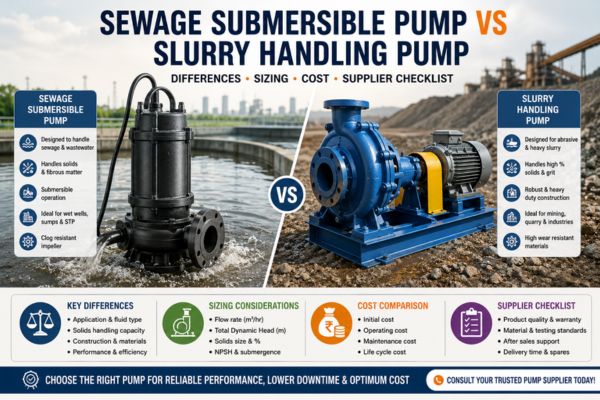
Understanding the technical distinctions between these two machines helps buyers avoid expensive operational mistakes.
| Pump Feature | Sewage Submersible Pump | Slurry Handling Pump |
|---|---|---|
| Primary Use | Pumping organic waste and soft solids | Pumping abrasive rock sand and hard minerals |
| Motor Location | Submerged underwater in the pit | Usually mounted externally on the surface |
| Solid Handling | Soft fibrous and easily compressible | Hard abrasive and high density particles |
| Construction Material | Cast iron or stainless steel | High chrome alloys or rubber lined casings |
| Wear Resistance | Moderate wear resistance | Extremely high wear resistance |
| Cooling Method | Cooled by surrounding liquid | Air cooled external motor |
Difference between sewage, sludge and slurry
To select the correct pump, buyers must first understand the fluid they are moving. Sewage is primarily water mixed with human waste, toilet paper, soft organic materials and light household chemicals. It has a high water content and flows relatively easily. Sludge is a thicker, semi solid byproduct of industrial processes or wastewater treatment. It has a much higher concentration of solids and a muddy consistency, making it harder to pump. Slurry is a mixture of water and highly abrasive, hard solid particles like gravel, metal shavings or mining ores. Slurry is heavy, dense and causes rapid mechanical wear on standard equipment.
Comparison of liquid type, solid size, abrasiveness, viscosity, installation and maintenance
When comparing these pumps across operational parameters, the differences become clear. Sewage pumps handle liquids with large but soft solids. The abrasiveness is low, and the viscosity is close to that of dirty water. Installation is simple because the pump is dropped into a pit with guide rails, making maintenance straightforward as the pump can be easily hoisted up.
Slurry handling pumps deal with highly abrasive fluids with variable particle sizes, ranging from fine ash to coarse stones. The viscosity can be very high depending on the solid concentration. Installation is more complex, usually requiring a dry surface foundation, strong baseplates and precise alignment. Maintenance on slurry pumps involves frequent replacement of wear parts like impellers and casing liners due to constant abrasion.
Applications in ETP, STP, chemical plants, construction sites, mining, ceramics, textiles and municipal wastewater
Sewage submersible pumps are the primary choice for Sewage Treatment Plants and municipal wastewater networks where organic waste must be lifted from deep underground sewers. They are also widely used on construction sites to drain muddy water from building foundations.
Slurry handling pumps are essential in mining operations for transporting crushed ore and in ceramic factories for moving clay mixtures. In Effluent Treatment Plants dealing with heavy industrial runoff, or chemical plants producing thick abrasive byproducts, slurry pumps provide the necessary durability. Textile mills use a combination of both, relying on sewage pumps for general wastewater and specialized slurry pumps for thick chemical dye sludge.
How to select the correct pump capacity and head
Selecting the right capacity and head prevents the pump from failing or consuming excess power. Capacity refers to the volume of liquid the pump can move per hour, usually measured in cubic meters per hour. You must calculate the total volume of your sump pit and how quickly it needs to be emptied during peak production hours.
Head refers to the total vertical height the liquid must be lifted, plus the friction resistance caused by the pipes, bends and valves. If you underestimate the head, the pump will run but no liquid will exit the discharge pipe. Always factor in an extra safety margin for head calculations, especially when pumping thick sludge that creates more pipe friction than clean water.
Importance of particle size and solid concentration
The physical properties of the suspended solids dictate the pump design. You must measure the maximum diameter of the solid particles in your fluid. The pump you choose must have a spherical solid handling capacity greater than your largest particle to prevent jamming. Solid concentration, which is the percentage of solid material compared to water, is equally critical. A liquid with ten percent solids behaves very differently than a liquid with forty percent solids. High solid concentrations increase the fluid weight, requiring a much larger motor horsepower and specialized impeller designs to prevent the solid particles from settling at the bottom of the pump casing.
Impeller selection and clogging prevention
The impeller is the heart of the pump. For sewage submersible pumps, vortex impellers or single channel impellers are preferred. A vortex impeller creates a whirlpool effect outside the impeller itself, meaning most solids pass through the pump casing without ever touching the metal blades, virtually eliminating clogs from stringy materials. For slurry handling pumps, fully open impellers with thick metal vanes are used to push heavy rocks and sand while resisting wear. Selecting the right impeller design is the most effective way to prevent costly downtime caused by manual unblocking procedures.
Material selection for abrasive and corrosive liquids
Using standard cast iron for acidic chemical sludge will result in the pump casing dissolving within a few months. For highly corrosive environments like chemical plants or textile dyeing units, pumps constructed entirely of Stainless Steel 316 or specialized polymer plastics are mandatory. When dealing with abrasive slurry like coal ash or river sand, the internal wear parts must be made of high chrome iron or coated with thick elastomer rubber. These specialized materials absorb the impact of sharp particles and extend the operational life of the equipment significantly.
Installation and maintenance considerations
Proper installation directly impacts the lifespan of the equipment. Sewage submersible pumps should be installed using a guide rail system. This allows operators to easily slide the pump down into the pit and pull it back up for maintenance without having to enter the dangerous, toxic environment of the sump. Ensure the electrical cables are properly sealed and protected from tension.
Slurry handling pumps require rigid, level concrete foundations to absorb heavy vibrations. Routine maintenance for both types includes checking motor insulation, inspecting mechanical seals for fluid ingress, and verifying that the impellers have not suffered excessive wear.
Common reasons for pump blockage, overheating and reduced flow
Even high quality pumps experience issues if they are applied incorrectly. Understanding the root causes helps maintenance teams resolve problems quickly.
| Problem | Possible Cause | Practical Solution |
|---|---|---|
| Pump is running but not delivering fluid | Air block in the casing or blocked suction | Vent the air or clear the suction inlet of large debris |
| Pump trips the electrical breaker | Motor is overloaded due to high fluid density | Upgrade motor horsepower or reduce fluid thickness |
| Reduced flow rate | Worn out impeller or clogged discharge pipe | Replace the worn impeller or flush the discharge pipeline |
| Excessive vibration and noise | Damaged bearings or cavitation | Replace bearings or increase the suction pressure |
| Motor overheating | Low liquid level exposing the submerged motor | Ensure liquid level switches are functioning correctly |
Operating cost and maintenance cost factors
The initial purchase price of an industrial pump is only a small fraction of its total lifetime cost. Power consumption accounts for the vast majority of operating expenses. An incorrectly sized pump will run outside its best efficiency point, drawing excess electricity and inflating energy bills. Maintenance costs are driven by the frequency of spare part replacement. Using cheap materials for abrasive slurry means replacing impellers and casings every few weeks, which costs more in parts and labor downtime than investing in a premium high chrome pump upfront. Focus on lifecycle costs rather than just the initial quotation.
Information buyers should provide before requesting a quotation
To get an accurate price and technical recommendation, buyers must provide clear operational data to the supplier.
| Parameter | Details Required by the Manufacturer |
|---|---|
| Liquid Properties | Name of the fluid, temperature, pH level and specific gravity |
| Solid Characteristics | Maximum solid size and percentage of solid concentration |
| Flow Rate | Desired capacity in cubic meters per hour |
| Total Head | Vertical lift and total length of the discharge pipe |
| Installation Type | Submersible installation or surface mounted requirement |
| Power Supply | Available voltage and electrical phase setup |
Checklist for selecting a manufacturer or supplier in Ahmedabad, Gujarat or India
When searching for a reliable Sewage Submersible Pump Manufacturer in India, you must evaluate their engineering capabilities and aftermarket support. If you are located in the western industrial belt, partnering with a Sewage Submersible Pump Manufacturer in Ahmedabad or a Sewage Submersible Pump Supplier in Gujarat offers distinct logistical advantages, including faster delivery and prompt onsite service.
Ensure the Sewage Submersible Pump Supplier in Ahmedabad has a fully equipped testing facility to verify pump performance before dispatch. Whether you need a standard unit or a heavy duty Slurry Handling Pump Manufacturer in India, look for suppliers who maintain large inventories of spare parts like mechanical seals, impellers and O rings to minimize your plant downtime.
Questions to ask a pump manufacturer
Before finalizing a purchase order, ask your supplier the following critical questions.
- Do you manufacture the pumps in house or just assemble imported components?
- Can you provide the performance curve graph matching our exact operating duty point?
- What is the standard lead time for delivering replacement wear parts?
- Do you offer onsite commissioning and alignment services?
- What type of mechanical seal is provided for our specific chemical application?
Transparent answers to these questions indicate a trustworthy and knowledgeable engineering partner.
Conclusion
Choosing between a sewage submersible pump and a slurry handling pump depends entirely on the nature of the fluid, the solid content and the installation environment. A sewage submersible pump is perfect for organic waste and deep underground sumps, while a slurry handling pump is mandatory for surface operations dealing with highly abrasive rock and sand mixtures. Proper sizing, correct material selection and partnering with a capable manufacturer are the keys to long term fluid handling success.
At Rinku Engineers, we specialize in designing and manufacturing heavy duty pumping solutions for the toughest industrial environments. Whether you need a reliable sewage pump for your municipal project or a robust slurry handling pump for your ETP, our technical team is ready to assist. Contact Rinku Engineers today to discuss your specific requirements and receive a customized technical proposal.
Frequently Asked Questions (FAQs)
No. Sewage submersible pumps rely on the surrounding liquid to cool their electric motors. Running them dry for extended periods will cause the motor to overheat and the mechanical seals to fail rapidly.
A channel impeller uses enclosed passages to push the fluid, offering higher efficiency but a slightly higher risk of clogging. A vortex impeller creates a whirlpool that pulls solids through the casing without them touching the blades, offering superior clog resistance but slightly lower energy efficiency.
Slurry handling pumps wear out because they constantly pump hard, sharp particles like sand, crushed stones or metal shavings. The severe friction caused by these materials grinds away the internal metal components over time.
Yes, you can use a slurry pump for clear water, but it is not economically practical. Slurry pumps consume more power and have higher initial costs. A standard centrifugal water pump is a much better choice for clear fluids.
To stop a sewage pump from clogging with stringy materials, you should use a pump equipped with a vortex impeller or install a specialized cutter pump that shreds the solid waste before it enters the main casing.
For acidic chemical sludge, standard cast iron is unsuitable. The best materials are high grade Stainless Steel 316, specialized polymer plastics or pumps lined with chemical resistant rubber elastomers.
Excessive vibration is usually caused by a blockage on one side of the impeller causing an imbalance, worn out internal bearings, or the pump operating too far off its best efficiency point on the performance curve.