

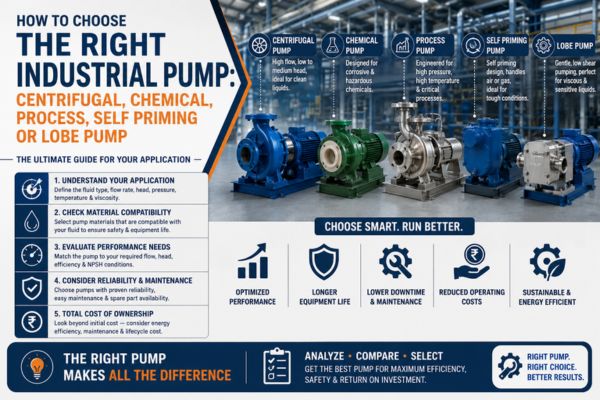
How to Choose the Right Industrial Pump: Centrifugal, Chemical, Process, Self Priming or Lobe Pump
Selecting an industrial pump for your plant is one of the most critical engineering decisions you will make. In many manufacturing units, pumps run continuously for hours, handling everything from cooling water to aggressive acids and thick syrups. When a pump works well, nobody notices it. When the wrong pump is installed, the entire production line can come to an unexpected halt.
A mismatch between your process fluid and your pump leads to recurring mechanical seal failures, frequent motor tripping, pipe leakages, high power bills and unsafe working conditions. In chemical and pharmaceutical manufacturing, an unexpected pump failure can also cause hazardous chemical spills and loss of expensive raw materials.
Whether you run a textile processing mill in Surat, a bulk drug facility in Hyderabad, a food plant in Pune or a wastewater treatment unit in Gujarat, choosing the right equipment saves operational headaches and money. This practical guide covers different pump technologies, their ideal applications and how to select the right design for your specific plant needs.
What is an Industrial Pump?
An industrial pump is a mechanical machine designed to transfer liquids, slurries and viscous fluids from one location to another through piping networks. Unlike small domestic water pumps, industrial pumps are engineered to withstand continuous heavy duty operation, wide temperature ranges, fluctuating pressures and corrosive chemicals.
These pumps fall broadly into two main families:
How Does a Centrifugal Pump Work?
A centrifugal pump is the most widely used fluid handling machine in modern industry. Its working principle relies on centrifugal force.
Fluid Enters Suction Eye -> Impeller Rotates at High Speed -> Fluid Accelerates Outward -> Volute Casing Converts Velocity to Pressure -> Liquid Discharges into Pipeline
The pump assembly contains two core parts: the rotating impeller and the stationary volute casing.
- Liquid enters through the suction nozzle and reaches the eye of the rotating impeller.
- As the motor spins the shaft, the impeller blades push the liquid outwards at high speed.
- The accelerating liquid enters the expanding chamber of the volute casing.
- As the flow passage widens, the kinetic velocity of the liquid drops, converting directly into discharge pressure.
- The pressurized fluid exits through the discharge pipe into the processing system.
Because of this simple design, a centrifugal pump has fewer rubbing parts, runs smoothly at standard motor speeds and delivers high flow rates with steady pressure.
Where Are Centrifugal Pumps Commonly Used?
Because they offer high mechanical efficiency and handle large liquid volumes economically, standard centrifugal pumps serve broad industrial duties across India:
Water Management: Boiler feed water circulation, cooling tower loops, raw water intake and high rise utility pumping.
Effluent and Utility Systems: Secondary wastewater circulation, domestic sewage handling in industrial parks and fire protection lines.
Textile and Dyeing Mills: Washing water loops, clear dye solutions, hot water circulation and fabric rinsing operations.
Agriculture and Irrigation: River water transfer, lift irrigation projects and raw bulk water conveyance.
Light Industrial Manufacturing: Machine tool cooling systems, spray washing lines and general liquid storage transfer.
If your process liquid is clean, has low viscosity similar to water and does not contain corrosive chemicals, a standard industrial centrifugal pump is almost always the most cost effective choice.
What is a Chemical Pump?
A chemical pump is a specialized pumping unit engineered specifically to transfer hazardous, toxic, volatile, flammable or abrasive chemical compounds without leaking into the plant atmosphere.
While a chemical pump frequently uses centrifugal hydraulic principles, its construction differs fundamentally from general utility pumps. It uses specialized corrosion resistant alloys or engineered non metallic polymers.
Key features of a chemical pump include:
- Thick walled pump casings to resist chemical erosion and internal pressure spikes.
- High grade mechanical seals such as single, double back to back or cartridge seals with silicon carbide, tungsten carbide and PTFE faces.
- Specialized barrier fluid systems to cool seal faces and prevent toxic vapor leakage.
- Heavy duty bearing brackets designed to withstand radial loads without shaft deflection.
Typical fluids handled include hydrochloric acid, sulfuric acid, nitric acid, caustic soda, plating baths, spent pickling liquors, solvents and acidic effluents.
What is a Chemical Process Pump?
A chemical process pump is a heavy duty, standardized horizontal end suction centrifugal pump built to international engineering standards such as ISO 2858, ISO 5199 or ASME B73.1.
These pumps are the workhorses of continuous process plants. Standardized dimensions allow plant engineers to interchange pumps from different manufacturers without altering pipeline alignments, foundation bolt positions or motor baseplates.
A standard chemical process pump features a back pull out design. This allows maintenance teams to remove the entire rotating assembly, including the impeller, shaft, bearings and seal, without disconnecting the suction and discharge pipe flanges or moving the electric motor. This single feature reduces planned maintenance downtime during plant turnarounds.
Explore our robust range of centrifugal process pump systems designed for heavy continuous duty in modern manufacturing.
Difference Between a Chemical Pump and a Standard Centrifugal Pump
Many plant buyers wonder why a chemical process pump costs more than a standard water centrifugal pump of the same flow rating. The difference lies in engineering design, metallurgy and seal integrity.
| Parameter | Standard Centrifugal Pump | Heavy Duty Chemical Pump |
|---|---|---|
| Primary Duty | Clear water, utilities, non aggressive fluids | Corrosive chemicals, toxic solvents, acids, alkalis |
| Body Metallurgy | Cast iron, mild steel, bronze, basic SS 304 | SS 316, SS 316L, Alloy 20, Hastelloy, PVDF, PFA, PP |
| Shaft Sealing | Traditional gland packing or simple mechanical seal | Cartridge double mechanical seal, external seal, API plan |
| Design Standard | General commercial standards | ISO 2858, ISO 5199, ASME B73.1 standards |
| Maintenance Setup | Full teardown often requires pipe disconnection | Back pull out design keeps pipe connections intact |
| Corrosion Allowance | Minimal wall thickness allowance | Generous corrosion allowance on wet parts |
Installing a standard water pump on an acidic or solvent line leads to rapid seal failure, bearing contamination and casing pitting within weeks.
What is a Process Pump and Where is it Used?
A process pump refers to any heavy duty pump built for continuous round the clock operation in mission critical production lines where unscheduled shutdowns are unacceptable.
These pumps are designed with larger shaft diameters to minimize shaft deflection, heavy duty bearing housings with oil lubrication, jacketed casings for heating or cooling and heavy duty baseplates.
Key industries relying on industrial process pumps include:
Petrochemicals and Refineries: Transferring hydrocarbons, thermal oils, glycol and aromatic compounds.
Bulk Drugs and Pharmaceuticals: Moving pure active pharmaceutical ingredient intermediaries, solvents, alcohol and sterile washes.
Fertilizer and Agrochemical Units: Pumping liquid ammonia, phosphoric acid slurries and urea solutions.
Pulp and Paper Plants: Moving chemical cooking liquors, bleaching chemicals and green liquor.
If your plant operation runs twenty four hours a day and your fluid is critical to product quality, an industrial grade process pump is essential.
When Should an Industry Choose a Self Priming Pump?
Standard centrifugal pumps cannot pump air. If air enters the suction pipe, the impeller becomes air bound, losing prime and running dry. A standard centrifugal pump installed above the liquid level requires foot valves, manual water filling or vacuum priming systems before starting.
A self priming pump overcomes this limitation. It features an integrated liquid reservoir built into its casing.
When you start the pump:
- The impeller mixes the air from the suction line with the liquid retained in the pump casing.
- This air liquid mixture moves to the discharge chamber, where the air separates and vents out through the discharge port.
- The heavier, deaerated liquid recirculates back to the impeller eye.
- This continuous loop creates a vacuum in the suction line, pulling the liquid upward until full prime is achieved.
Ideal Applications for Self Priming Pumps
Effluent Treatment Plants (ETP): Pumping sludge, untreated wastewater and equalization tank contents from underground sumps.
Dewatering and Stormwater: Emptying flooded factory basements, construction pits and drainage channels.
Chemical Tanker Unloading: Emptying road tankers from the top opening where bottom drainage valves are absent.
Marine and Port Applications: Bilge water removal and dockside drainage where suction lifts fluctuate.
Learn more about reliable suction lift solutions through our industrial self priming pump range.
When is a Lobe Pump a Suitable Choice?
Centrifugal pumps operate at high rotational speeds, which creates high shear forces inside the casing. For sensitive liquids or thick viscous fluids, high shear can alter product consistency, break down emulsions or damage solid particles.
A lobe pump is a positive displacement rotary pump that uses two counter rotating lobe rotors. The rotors turn inside a spacious casing without touching each other or the pump walls.
Lobe Rotors Turn -> Cavities Form at Inlet -> Fluid Enters Pockets -> Liquid Travels Around Outer Casing -> Fluid Discharges Smoothly at Outlet
Why Choose a Lobe Pump?
Gentle, Low Shear Handling: Perfect for delicate fluids that shear easily, such as yogurt, creams, biological slurries, cell cultures and latex emulsions.
Handles High Viscosities: Moves high viscosity fluids effortlessly, including honey, chocolate, toothpaste, starch paste, sugar syrups, paints and polymers.
Reversible Operation: Changing the motor rotation reverses the flow direction, making line clearing and tanker loading simple.
Hygienic CIP and SIP Compliance: Highly polished stainless steel wet parts with no dead pockets make them ideal for food, beverage and pharmaceutical sanitary processing.
For smooth handling of viscous and shear sensitive media, check our precision engineered sanitary and industrial lobe pump systems.
Best Pump Options for Acids and Corrosive Chemicals
Pumping harsh acids requires careful selection of wet end materials and sealing systems. As a dedicated acid handling pump supplier in India, we evaluate chemical concentration, working temperature and the presence of dissolved solids before recommending a configuration.
Here are common acid duties and their proven pump solutions:
Hydrochloric Acid (HCl):
Highly aggressive to most stainless steels. Non metallic chemical pumps lined with Polypropylene (PP), Polyvinylidene Fluoride (PVDF) or Perfluoroalkoxy (PFA) are standard. For seal safety, magnetic drive seal less pumps or non metallic mechanical seal pumps are preferred.
Sulfuric Acid (H2SO4):
Concentrated sulfuric acid (above ninety three percent) at room temperature can be handled by Cast Iron or Alloy 20. Dilute or hot sulfuric acid is extremely aggressive and requires High Silicon Iron, Alloy 20, Hastelloy C or solid PVDF lined chemical process pumps.
Nitric Acid (HNO3):
Highly oxidizing. Stainless Steel 304L, SS 316L and specialized titanium alloys work well, provided mechanical seal faces use pure silicon carbide or ceramic materials.
Phosphoric Acid:
Common in fertilizer processing. Requires SS 316, Alloy 20 or rubber lined centrifugal slurry pumps to handle both acid corrosion and abrasive rock particles.
Caustic Soda (Sodium Hydroxide):
Handled using ductile iron, SS 316 or nickel alloys. For high temperatures, jacketed casings prevent caustic crystallization during shutdowns.
For specific acid handling guidelines, contact our technical team to discuss dedicated engineered chemical pump solutions.
Industrial Pump Selection: Technical Comparison
This comparison table provides a quick reference to evaluate which pump technology fits your plant requirements.
| Pump Type | Suitable Liquids | Main Applications | Major Benefits | Important Limitations |
|---|---|---|---|---|
| Standard Centrifugal Pump | Clean water, light utilities, thin liquids | Water supply, cooling towers, general utility, boiler circulation | High efficiency, low initial cost, simple maintenance | Cannot handle air, poor performance on high viscosity fluids |
| Chemical Process Pump | Corrosive chemicals, acids, solvents, hazardous liquids | Chemical plants, pharma bulk drugs, refineries, dye manufacturing | Robust back pull out design, wide metallurgy options, reliable sealing | Higher capital investment, requires flooded suction or priming system |
| Self Priming Pump | Raw wastewater, chemical effluents, slurry with solids | ETP sumps, tanker unloading, trench dewatering, industrial drainage | Primes automatically without foot valve, handles air and debris | Lower hydraulic efficiency compared to standard end suction pumps |
| Rotary Lobe Pump | High viscosity liquids, shear sensitive fluids, pastes | Food processing, dairy, cosmetics, pharma creams, polymer paste | Low shear handling, reversible flow, dry run capability for short periods | Higher unit cost, strictly requires pressure relief valve on discharge |
How to Select a Pump: Technical Checklist
To select the right industrial pump, collect these six core operational parameters before requesting a manufacturer quote:
Flow Rate + Total Head + Temperature + Viscosity + Solids + Metallurgy = Correct Pump Selection
Common Industrial Pump Selection Mistakes
Avoiding these common engineering pitfalls will save money and prevent unexpected plant downtime:
Oversizing the Pump:
Many plant engineers add excessive safety margins to flow and head calculations. An oversized centrifugal pump operates far to the right of its Best Efficiency Point (BEP), causing shaft deflection, cavitation, excessive vibration and premature bearing failure.
Ignoring Net Positive Suction Head (NPSH):
If the available suction pressure (NPSHa) is lower than the pump requirement (NPSHr), liquid vaporizes at the impeller eye. The collapsing vapor bubbles cause cavitation, which erodes the metal impeller and destroys mechanical seals.
Selecting the Wrong Mechanical Seal Face Material:
Using carbon faces on abrasive slurry lines causes rapid seal face grooving. Silicon carbide against silicon carbide is required for abrasive fluids.
Omitting Suction Strainers on Clean Liquid Pumps:
Forgetting to install a proper suction strainer allows welding slag, pipe scale and foreign debris to enter closed impellers, leading to immediate mechanical jamming.
Running Positive Displacement Pumps Against Closed Discharge Valves:
Unlike centrifugal pumps, lobe pumps cannot operate against a closed valve. Without an integrated pressure relief valve, pressure rises rapidly, rupturing pipelines or burning out the drive motor.
Questions to Ask a Pump Manufacturer Before Requesting a Quotation
Before finalizing your commercial purchase order, discuss these questions with your pump supplier:
- What is the recommended pump operating speed (1450 RPM versus 2900 RPM) for our liquid characteristics?
- Does the pump performance curve run near the Best Efficiency Point (BEP) at our operating duty point?
- What is the Net Positive Suction Head Required (NPSHr) at the specified operating flow?
- What mechanical seal brand, model and API piping plan are included in your proposal?
- Are the pump wet end components cast, forged or machined from solid bar stock?
- What standard testing procedures are performed before dispatch (hydrostatic pressure testing, dynamic balancing and performance testing)?
- What is the lead time for standard consumable spare parts like mechanical seals, gaskets, impellers and shaft sleeves?
Why Reliable Manufacturing Support and Spare Parts Availability Matter
Buying an industrial pump is not just a one time purchase. It is a long term operational commitment. Over a ten year lifecycle, the initial purchase price of an industrial pump accounts for less than fifteen percent of its total operating cost. Power consumption, routine maintenance and unscheduled downtime account for the remaining eighty five percent.
Partnering with an established Indian pump manufacturer gives your plant key advantages:
Fast Spare Parts Availability:
Readily available mechanical seals, impellers, shafts and casing gaskets mean your plant is never stranded waiting weeks for imported replacement parts.
Application Engineering Support:
Experienced application engineers review your process parameters and suggest practical design modifications to avoid recurring failures.
Customized Metallurgical Options:
Access to tailored material combinations matches specific chemical compositions and temperature profiles.
Direct After Sales Technical Service:
Local service engineers can troubleshoot vibration issues, alignment problems or seal leaks on site.
Conclusion
Every industrial pump type has distinct operational strengths. Standard centrifugal pumps deliver economical utility water transfer. Chemical process pumps handle hazardous corrosive fluids safely. Self priming pumps resolve complex suction lift challenges in wastewater systems. Lobe pumps protect viscous, shear sensitive food and pharmaceutical mixtures.
Choosing the right equipment requires balancing fluid chemistry, operating pressure, temperature and long term lifecycle costs.
At Rinku Engineers, we manufacture robust, precision engineered industrial pumps built to handle demanding Indian operating conditions. Whether you need an acid handling chemical pump, a heavy duty centrifugal process pump, a self priming unit or a hygienic lobe pump, our engineering team is ready to assist.
Need help selecting the right pump for your plant? Contact our application engineers today through our official contact page to discuss your technical requirements and receive a detailed quotation.
Frequently Asked Questions (FAQs)
An end suction centrifugal pump requires the pump casing and suction pipe to be completely filled with liquid before starting. A self priming pump features an integrated liquid chamber that automatically evacuates air from the suction pipe during startup, allowing it to lift liquid from below the pump centerline without an external foot valve.
No. Standard chemical process pumps with mechanical seals must never run dry. The liquid inside the pump lubricates and cools the mechanical seal faces. Running dry causes rapid heat buildup, thermal shock, seal face cracking and catastrophic chemical leakage within minutes.
For organic solvents, hot alkaline solutions, pharmaceutical intermediates and high temperature chemicals, Stainless Steel 316 or 316L is typically preferred. For strong inorganic mineral acids like hydrochloric acid, hydrofluoric acid or concentrated ferric chloride, non metallic pumps made from Polypropylene (PP), PVDF or PFA offer superior chemical resistance against pitting and localized corrosion.
Excessive pump vibration is commonly caused by shaft misalignment with the motor, operating far away from the Best Efficiency Point, cavitation due to low suction pressure (NPSHa), bent shafts, damaged internal bearings, unbalanced impellers or loose foundation mounting bolts.
A back pull out design allows maintenance personnel to dismantle the bearing housing, shaft, seal assembly and impeller without removing the pump casing from the suction and discharge pipelines. It saves labor time and eliminates the need to realign piping during routine overhauls.
A lobe pump operates at lower rotational speeds and generates gentle positive displacement action with minimal shear stress. This prevents the degradation of delicate emulsions, protects fragile solid pieces like fruit chunks and ensures consistent viscosity in thick pastes, creams, gels and syrups.