

Handling thick, sticky, or delicate liquids requires specialized industrial equipment. When standard centrifugal pumps fail, plant engineers turn to robust positive displacement pumps to get the job done. Among these, the lobe pump stands out for its exceptional performance.
Understanding the rotary lobe pump working principle helps operators maintain their equipment better and improve plant efficiency. In this comprehensive guide, the technical experts at Rinku Engineers explain how these versatile machines operate. We will explore their components, various types, major advantages, and common industrial applications.
What Is a Rotary Lobe Pump?
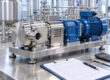
A rotary lobe pump is a highly efficient positive displacement pump. It uses two rotating lobe-shaped impellers to move fluid through a sealed casing. Unlike standard water pumps that use high speed to throw liquid, a lobe pump gently pushes the liquid forward in fixed volumes.
These pumps are famous for their hygienic design and ability to handle highly viscous liquids without damaging the fluid structure. Because of this gentle action, an industrial lobe pump is the standard choice for the food, pharmaceutical, and chemical
Rotary Lobe Pump Working Principle
Understanding the rotary lobe pump working principle is simple once you know how the internal parts interact. The design relies on precise timing and clear physical clearances.
How Does a Rotary Lobe Pump Work?
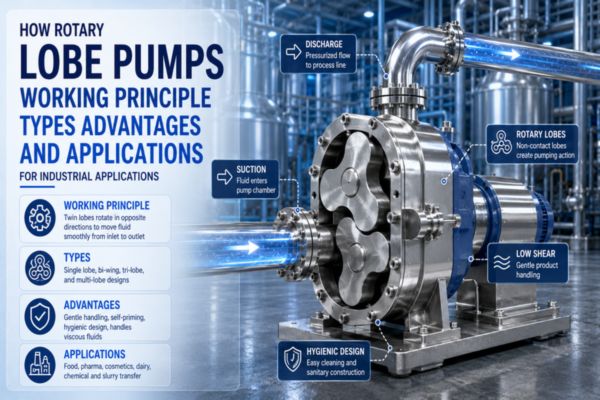
A rotary lobe pump works by using two rotating lobes that turn in opposite directions inside a casing. As the lobes spin, they create expanding cavities that draw liquid in. The lobes then trap the liquid and push it toward the discharge port without ever touching each other.
Step-by-Step Pumping Process
The pumping action happens in three continuous steps:
- Inlet Suction: As the lobes rotate out of mesh on the suction side, the cavity volume increases. This creates a vacuum that pulls the liquid into the pump casing.
- Fluid Transfer: The spinning lobes trap the liquid in the pockets between the lobe edges and the outer casing. The lobes carry the fluid around the outside interior of the pump.
- Discharge: As the lobes come back into mesh on the discharge side, the cavity volume decreases. This action forces the fluid out of the pump and into the discharge pipe under pressure.
Main Components of a Rotary Lobe Pump
A reliable Lobe Pump requires precision-machined components to operate smoothly.
Types of Rotary Lobe Pumps
Different applications require different lobe designs. Here are the main rotary lobe pump types:
Bi-lobe pump
A bi-lobe pump features rotors with two large lobes. It is excellent for pumping liquids containing large, soft solid particles without crushing them.
Tri-lobe pump
A tri-lobe pump uses rotors with three lobes. It provides a smoother fluid flow with fewer pressure pulsations than a bi-lobe design.
Multi-lobe pump
Multi-lobe pumps have four or more lobes on each rotor. They offer extremely smooth flow and precise fluid metering for highly sensitive applications.
Sanitary lobe pump
A sanitary lobe pump features smooth, crevice-free internal surfaces. Food and pharma plants use them because they are incredibly easy to clean and sterilize.
Heavy-duty industrial lobe pump
Industrial models use thicker casings and heavy-duty bearings. They effortlessly handle abrasive chemicals, harsh sludges, and high-pressure applications.
Different Lobe Profiles
Engineers design lobe profiles to match the fluid. Wing-nut lobes handle large solids easily. Scimitar lobes are great for sticky fluids. The classic tri-lobe profile remains the industry standard for balancing smooth flow with good solid-handling capabilities.
Advantages of Rotary Lobe Pumps
The rotary lobe pump advantages make it indispensable in modern processing plants:
- Gentle pumping: Low shear action protects delicate fluids like yogurt and lotions.
- Solid handling: Passes soft solids like fruit pieces without mashing them.
- Reversible operation: Can pump fluid in either direction by reversing the motor.
- Dry running ability: Can run dry for short periods if fitted with properly flushed seals.
- Hygienic design: Easy to clean using CIP (Clean-In-Place) systems.
Limitations of Rotary Lobe Pumps
Every pump has limitations. Lobe pumps have a higher initial purchase cost than basic centrifugal pumps. They also require a separate timing gearbox, which increases the pump’s physical footprint. Finally, they experience “slip” (internal fluid leakage) when pumping very thin liquids like water.
Fluids Handled by Rotary Lobe Pumps
A lobe pump for viscous liquids handles materials that other pumps cannot. They easily move thick honey, peanut butter, toothpaste, heavy resins, and thick cosmetic creams. They also act as a reliable sludge lobe pump for thick wastewater mud.
Rotary Lobe Pump Applications
Rotary Lobe Pump vs Gear Pump
Both are positive displacement pumps, but they differ internally. A rotary gear pump has interlocking gears that touch each other. A lobe pump has timing gears that prevent the lobes from touching, making it much better for handling solids and hygienic fluids.
Rotary Lobe Pump vs Centrifugal Pump
A centrifugal pump uses high-speed kinetic energy to move thin liquids like water. A lobe pump uses slow-moving cavities to push thick, viscous liquids. For more selection details, read our complete Lobe Pump Selection Guide.
Required Comparison Table
| Comparison Factor | Rotary Lobe Pump | Gear Pump | Centrifugal Pump |
|---|---|---|---|
| Pumping Principle | Positive displacement | Positive displacement | Kinetic energy |
| Suitable Viscosity | High to very high | Medium to high | Low (water-like) |
| Solid Handling | Excellent | Poor (gears touch) | Fair (depends on impeller) |
| Shear Level | Very low (gentle) | High | High |
| Self-Priming Ability | Yes (when wet) | Yes | No (requires foot valve) |
| Reversible Operation | Yes | Yes | No |
| Typical Application | Food, pharma, sludge | Oils, fuels, resins | Water, thin chemicals |
| Maintenance Requirement | Medium | Low to medium | Low |
Factors That Affect Lobe Pump Performance
Performance changes based on fluid viscosity, operating temperature, and discharge pressure. Thicker liquids actually improve pump efficiency by sealing the small gaps between the lobes and casing. High temperatures require special rotors that expand safely without scraping the metal casing.
Common Lobe Pump Problems
Common issues include worn mechanical seals leaking fluid. If the timing gears wear out, the lobes can hit each other, causing severe internal damage. A sudden drop in flow rate usually means the internal lobe clearances have worn too wide due to abrasive liquids.
Rotary Lobe Pump Maintenance Tips
Check the gearbox oil level regularly to protect the timing gears. Inspect mechanical seals monthly for small drips. Always ensure the pump casing is properly flushed and cleaned after pumping sticky fluids that harden when dry.
When Should You Choose a Rotary Lobe Pump?
Choose a lobe pump when you need to move thick, shear-sensitive fluids that contain soft solids. They are the best choice when strict hygiene, easy cleaning, and gentle fluid handling are your top plant priorities.
Choosing a Rotary Lobe Pump Manufacturer Supplier and Exporter
Selecting the right partner is crucial. Look for an industrial lobe pump manufacturer that understands your specific industry requirements. A good supplier will help you calculate viscosity limits, select proper seals, and provide reliable after-sales support.
Rotary Lobe Pump Manufacturer Supplier and Exporter in Ahmedabad
Rinku Engineers is a premier rotary lobe pump manufacturer, supplier, and exporter in Ahmedabad, Gujarat, India. We proudly manufacture AYUSH PUMPS for demanding industrial, chemical, and hygienic applications worldwide.
We strongly believe in application-based selection. Our expert engineering team provides comprehensive viscosity evaluation to ensure your pump operates at peak efficiency. We offer multiple material options and precise seal selection tailored to your exact liquid characteristics. Every pump undergoes strict quality inspection before leaving our facility.
As a trusted lobe pump supplier in Gujarat and a prominent rotary lobe pump exporter from India, we provide rapid spare-parts support and robust export packaging for safe global transit. From detailed technical guidance to lifelong maintenance assistance, Rinku Engineers guarantees long-lasting pumping solutions for your processing plant.
Rinku Engineers Rotary Lobe Pump Solutions
Whether you need a sanitary pump for delicate dairy products or a heavy-duty pump for thick industrial sludge, we have the right equipment. Visit our Homepage to explore our complete range of high-performance fluid handling solutions.
Conclusion
Understanding the rotary lobe pump working principle helps you appreciate why these machines are so vital for modern manufacturing. With their gentle pumping action, excellent solid handling, and highly hygienic designs, they outperform other pumps in viscous liquid applications.
If you are ready to upgrade your fluid transfer system, contact Rinku Engineers today. To help our technical team find the perfect pump for your plant, please share your:
- Liquid name
- Viscosity
- Temperature
- Solid content
- Required flow rate
- Operating pressure
- Material preference
- Seal requirement
Frequently Asked Questions (FAQs)
The rotary lobe pump working principle involves two non-contacting lobes rotating in opposite directions inside a casing. As they turn, they create expanding cavities that draw liquid in, trap it, and gently push it toward the discharge port without crushing the fluid.
Yes, it is a type of positive displacement pump. It moves fluid by repeatedly enclosing a fixed volume of liquid and moving it mechanically through the system, regardless of the discharge pressure.
Absolutely. They are highly suitable for handling thick, viscous liquids like honey, peanut butter, cosmetic creams, and thick industrial sludges. In fact, their efficiency actually increases when pumping thicker fluids.
Yes, they handle solids very well. Because the internal lobes never physically touch each other, they can easily pass soft solids like fruit pieces, cheese curds, and biological waste without crushing or damaging them.ical
Yes, they have self-priming capabilities, provided the pump casing contains some liquid (wetted). The liquid seals the internal clearances, allowing the pump to pull a vacuum and draw fluid up the suction pipe.
The main difference is internal contact. In a gear pump, the gears touch each other to push fluid. In a lobe pump, external timing gears keep the lobes separated, preventing wear and allowing safe passage of solids.
They can run dry for short periods without damaging the lobes because the lobes do not touch. However, the mechanical seals must be specially designed or externally flushed to prevent them from overheating during dry runs.
Food plants use them because of their hygienic, crevice-free design. They are incredibly easy to clean and sterilize. Furthermore, their low-shear action transfers delicate foods without ruining their texture or shape.
They handle a wide variety of liquids, including dairy products, fruit pastes, chemical resins, pharmaceutical syrups, cosmetic lotions, thick paints, and wastewater sludges.
Choose a trusted sanitary lobe pump supplier like Rinku Engineers that offers application-based selection. Ensure they provide accurate viscosity calculations, proper material choices, rigorous quality testing, and dependable spare-parts support.